
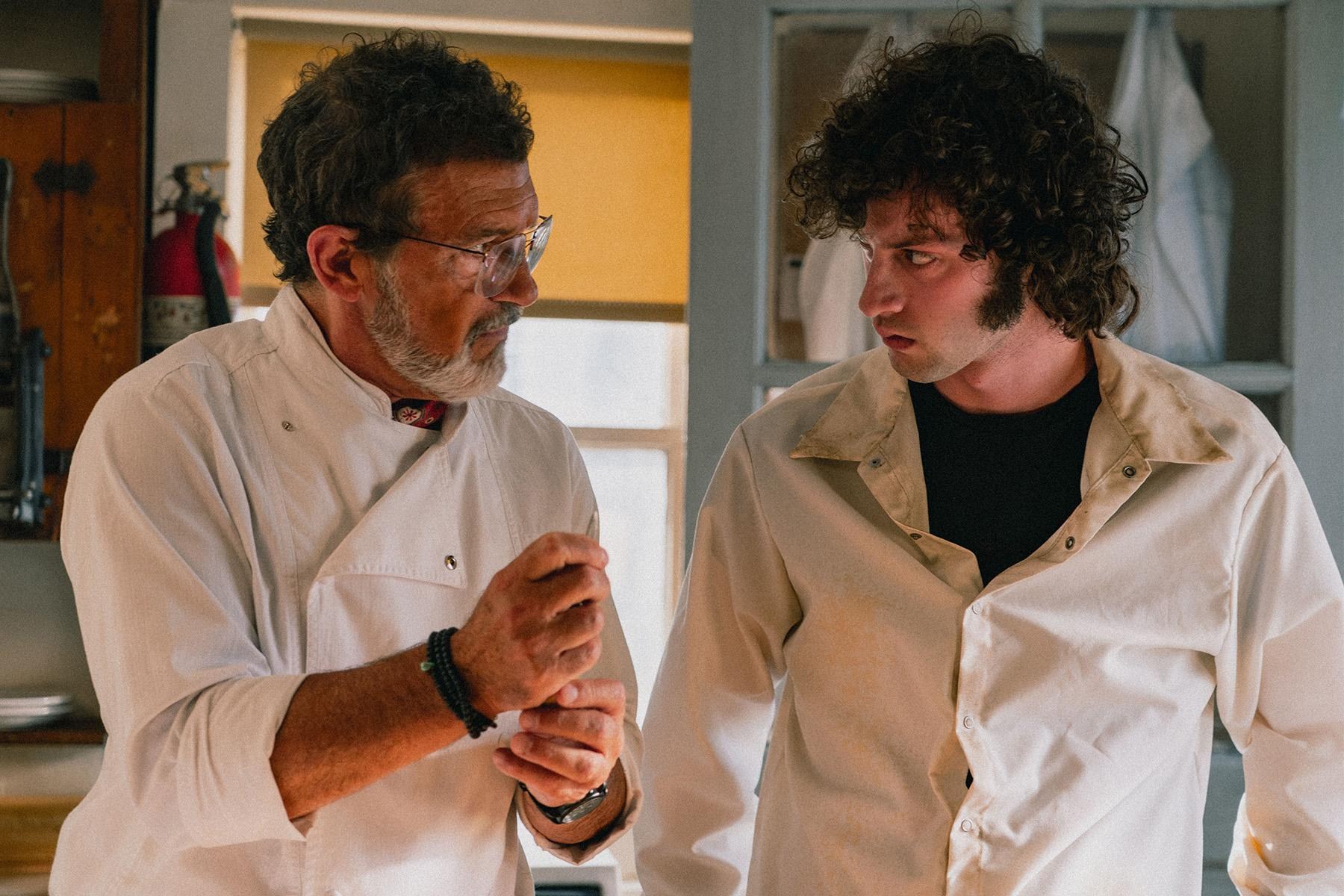
Dominic Sessa and Antonio Banderas in ‘Tony.’ Credit: A24 | A24
There are two types of biopics: those that unconventionally show, and those that exhaustively tell. Thank goodness that Tony, the highly anticipated A24 biopic about the late Anthony Bourdain, takes the former route. “When we are writing a biopic,” screenwriter Todd Bartels told me, “[co-writer Lou Howe and I] are allergic to cradle-to-grave narratives. We like to pick a window on someone’s life that serves as a microcosm for their longer journey.” In this instance, that window is the summer of 1975, when a young Tony first cuts his chops in a Provincetown, Massachusetts, kitchen. “[It’s] more a movie about the relatable arc of knowing who you want to be but not quite knowing how to get there and raging against that,” writes Eater’s Bettina Makalintal in her review of the film, and “it happens to be a movie about someone we all loved.”
Then again, successfully pitching a Bourdain biopic to his estate was always going to be a big swing. I spoke with Todd Bartels and Lou Howe about what made that swing possible (for one: bringing on Kimberly Witherspoon, Bourdain’s literary agent and friend, as an executive producer); which cast member demonstrated the best culinary chops; and who they could imagine playing an older, more seasoned Anthony Bourdain.
Eater: How did you strike the balance between making a movie for the passionate Anthony Bourdain fans, and viewers who may know very little about him?
Lou Howe: I was anxious about that [laughs], especially at the very beginning. But [we] just [tried] to make a good movie, and hope that the entertainment factor and emotional engagement hits the target well enough. We started this whole process as fans, so in that way we felt relatively comfortable servicing fellow fans. You want to write a good story that people can plug into no matter who the character is. Of course, there are some Kitchen Confidential Easter eggs.
Such as?
LH: The bride story, the time he picked up a hot pan and [naively] asked for burn cream…
How did you manage to tap into the emotional, and not just factual, truths of Bourdain’s story?
Todd Bartels: As [Lou] mentions, when we work on a biopic we’re very allergic to cradle-to-grave narratives. We prefer to focus on a window in someone’s life. The biography written by Laurie Woolever, who was Bourdain’s longtime assistant and collaborator, was essential at helping us answer questions like, How did this person “in need of a good ass kicking” — as Bourdain famously wrote about himself as a young man — become this enlightened figure for so many people? He wrote that he treated the world like his ashtray, that he was narcissistic and insufferable. How do you go from little shit to guru?
How did you gain the trust of Bourdain’s estate?
LH: That was a multistep process. We knew we had to go to the estate first, and our executive producer, Emily Rose — who is also a big Bourdain fan — chased down Kimberly Witherspoon, Bourdain’s literary agent and someone who helped build his career as a writer. Witherspoon and Ottavia Busia-Bourdain are the executors of the estate, and [Rose] was finally, after much chasing, able to get us a meeting with them.
What was the elevator pitch?
LH: That it would be a love letter: a Provincetown summer coming-of-age story that ends in a clambake. [Witherspoon and Busia-Bourdain] were kind of like, “Well, that’s different from what we’ve been getting pitched,” which was a lot of stuff focusing on his later years, and trying to understand his death. We rejected that consciously. They liked that idea, but basically said, “Prove it,” so we then went back to them when we had a script, and A24 involved, and [co-writer and director] Matt Johnson and Dominic Sessa; those two kind of came on board as a team. [Witherspoon] also came on board as an executive producer and was very creatively involved throughout everything.
Was anyone else considered to play Bourdain?
LH: It was always Dom.
Who do you think could play an older version of Bourdain?
TB: That’s such a fun thing to think about, and no one has asked us that yet. I have two thoughts, amongst many, but a friend once suggested Bobby Cannavale. I can see it.
LH: And [Cannavale] would really have the voice down.
TB: Yes, but then another friend — and I love this [casting] even more, suggested Eric Bogosian.
Kim Witherspoon knew Bourdain so well. How did her input impact the film?
TB: She’s really one of the keepers of his legacy, and would help us to gut-check these moments where we’d be like, “Okay, does this feel like your friend?” We were always surprised at how she wanted us to get even darker. She’d say, “No, don’t make him so nice. [At this stage] he was a punk.” We were showing the devil and angel on his shoulder, as represented respectively by the characters Sal, who was played by Leo Woodall, and Ciro, the chef played by Antonio Banderas. She insisted that we really not sanitize that [journey].
LH: She didn’t want him to look like the innocent little victim of bad influences. The whole idea of having Eric Ripert make a cameo was also her idea.
What was Eric Ripert like on set? That must have been emotional.
TB: Well, Ripert is a Buddhist, always wearing his mala beads, and was extremely humble and just curious about the acting process. At no point was he swaggering around like the grand chef from Le Bernardin that he is [laughs].
LH: It was such an honor. With him and [Witherspoon] being involved, it really just felt like we had the people who loved him honoring him the right way.
Can you tell me more about the on-set food logistics?
TB: Christine Tobin was our food culinary consultant, and was there every day making all the food in a little shack behind the kitchen. I think Dom [Sessa] ate like, eight lobster rolls at a time [laughs]. Leo Woodall also became unbelievable at shucking an oyster. He made it look effortless, which is also such an important aspect of his character.
LH: Antonio [Banderas] is also a restaurateur. Leo [Woodall] and Dom [Sessa] trained beforehand in kitchens, but [Banderas] didn’t need any help. In fact, during a lot of scenes, he’s actually off to the side making paella.
Wait, Antonio Banderas was literally just always making paella on set?
LH: Yeah! Incredible, right? He just loves to do it — which, again, was also so perfect for his role as the chef as well.
Were there any other scenes or moments you would have loved to show in the movie?
LH: I have one that comes to mind that was never shot. Bourdain’s favorite hot dog stand is this spot called Hiram’s in Fort Lee, New Jersey, and in earlier drafts of the script we see him head to this place — a real childhood favorite, and a true greasy spoon haunt — to see the amount of joy that it gives him. It’s a first insight into his relationship with food.
TB: Provincetown’s history as this Portuguese fishing town, too, is also [front and center]. There’s a kind of melancholic, longing singing known as fado in Portuguese culture. If you pay attention, you can hear it in the background during the striper run scene and when Tony and Ciro are sitting by a bonfire. At one point, we were going to have an actual fado singer’s character who was perhaps the unrequited love of Antonio [Banderas’s] character. But we wanted his character’s backstory to be more mysterious.
How did you familiarize yourself with that old-school Provincetown energy?
TB: We hung out for the better part of two days at Bourdain’s favorite dive bar, the Old Colony Tap, which is still there on the main drag of Commercial Street, and covered in all of its maritime flotsam and jetsam, Red Sox [memorabilia] glory. I’d say it’s the best bar in America.
LH: Totally. Put it on the Eater map! [Laughs]
Tony is in theaters August 21, 2026.