
This excerpt was originally published in Pre Shift, our newsletter for the hospitality industry. Subscribe for more first-person accounts, advice, and interviews.
Now Open is a yearlong series celebrating some of 2026’s most exciting new restaurants. Throughout the year, we’ll check in with teams in Chicago, New York City, and Washington, D.C. to hear what it’s really like behind the scenes of a buzzy opening. Then, we’ll host exclusive meals at these restaurants as part of Dinner Party, presented by Capital One. Read along for challenges, candid reflections, and advice from the proprietors behind some of the country’s hottest new openings.
After opening in 2016, Tail Up Goat quickly became D.C.’s go-to fine dining restaurant for celebrations of all sizes, racking up national accolades including a Michelin star and James Beard Award nods. But after nearly a decade of service and a wave of new challenges for the hospitality industry, the restaurant’s owners knew they needed to make a big change.
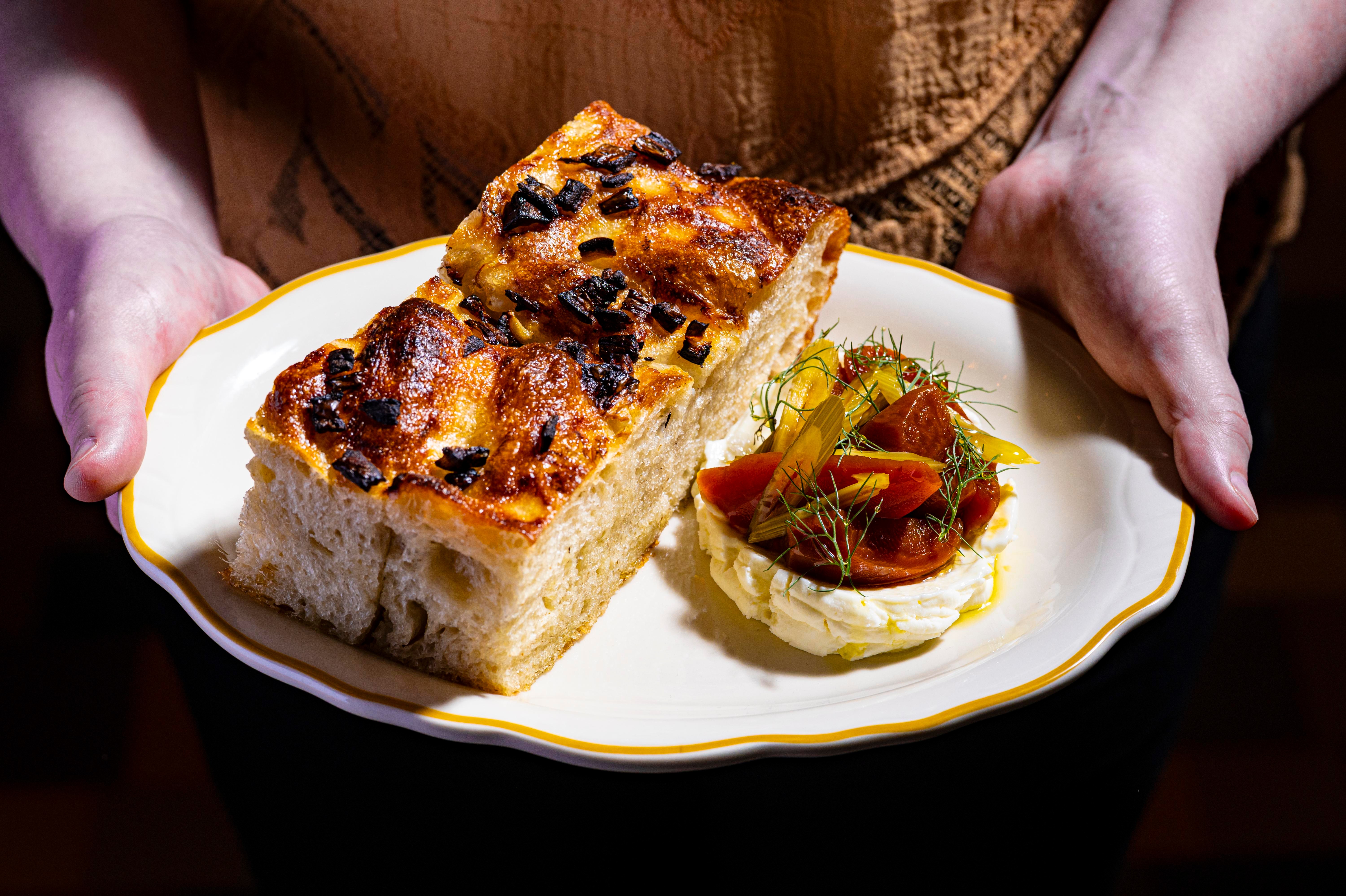
Rather than give up the lease to their Adams Morgan spot, co-owners Jill Tyler and Jon Sybert decided to shift the concept into a counter-service model called Rye Bunny. Guests file into the restaurant and order before shifting into table service that feels exactly like your standard restaurant experience. Tyler and Sybert say this fresh concept gives guests access to the same top-notch seasonal dishes—just in a format that they believe is better for both guests and staff. As the couple launches this reimagined concept, we checked in with Tyler to learn more about how they melded Rye Bunny to fit changing dining habits while supporting the team’s mission to make hospitality careers more sustainable.
Liz Provencher: After running Tail Up Goat for nearly 10 years, what made you decide to shift into a more casual concept?
Jill Tyler: We were coming up on our 10-year lease and deciding what was next. I don’t know that we were sure it was restaurants. The last five years, post-pandemic have been incredibly challenging in many, many ways, and we weren’t really sure what we were going to do. Then my friend Arjav, who has a restaurant in Austin called Birdie’s, said, “You need to open a counter-service restaurant. It’s the only way restaurants are going to work moving forward. This is what you should be doing and the model you should be looking at.”
Were you immediately sold?
I was really reticent. At that point, I’d only ever seen counter service equal fast-casual, and that’s not what I wanted to run. There are a lot of great things about that side of the business. And it certainly can be very profitable, especially if you look at some of the IPOs that have come out of D.C. in the last 10 years. But it wasn’t what I love about what I do. So I went to Austin and staged with him. An hour into my stage, he was like, “What are you going to do?” And I said, “I’m going to open a counter-service restaurant.”
So what changed your mind?
I think restaurants are kind of broken so I didn’t want to build something that didn’t work again. Even if it might have worked when we were new and everyone wants to see the new thing for a year, that isn’t a sustainable business. We knew the things that were really important to us: providing competitive wages, PTO, and healthcare. All these things make it a much more expensive business to run, so we started with our non-negotiables and then tried to figure out how we could build a sustainable business that occupies the middle responsibly.
There’s nothing inexpensive about going out to eat anymore at all. It’s a treat to do no matter what level you’re doing it at. So for us, it was like, okay, how do we responsibly occupy a middle space that might be something where neighborhood folks come in every other week and for other people it’s a special occasion? [And] how do we do that in a way that aligns with our values and who we want to be as owners? That’s how we ended up with Rye Bunny. Jon and I want to run something where we build a community—and that means you have to be more accessible, so that’s how we’re here.
What were the major pain points you wanted to solve with this new concept?
The main pain point at Tail Up Goat post-pandemic was that everything was more expensive. You have yearly rent increases, you have inflation that’s done a number on food and wages, and healthcare premiums going up anywhere between 12 and 17 percent every year, year over year. All the things that were important for us to provide became much more expensive.
Dining habits also just changed. We were no longer seeing one, two turns on a weekday. We were filling reservations between 6 and 8 p.m., but we never got back to seating until 10 p.m. So much of it changed in a way where the pieces just didn’t fit back together.
Why do you think counter service is a more sustainable model?
One of the main things we had to figure out was labor. We were running a $100,000 payroll every two weeks and that is not sustainable. This model allows us to run with fewer people. [Compared to Tail Up Goat,] the back-of-house [staff size has] one fewer person in the morning and one fewer person in the evening, still putting out this amazing food. But on the front-of-house side, we don’t have hosts anymore, and we’re running with one fewer manager and two fewer servers, so we’ve cut our team pretty significantly.
With this counter-service [and] full-service hybrid model, you still have a server and a team of people taking care of you once you sit down. I don’t think it feels lacking. We didn’t want to open a business that pulled back on hospitality because that’s our favorite part of going out to eat. It’s just repackaged in how it all comes together.
Giving back to the community also seems to be important to you and Jon, and I know that you offer limited reservations with a fee that’s donated to charity. Can you tell me more about that?
Before COVID, we had been able to give $100,000 in cash to organizations that we wanted to support in D.C. through event fundraising efforts a few times a year. It was truly remarkable when I look back. But after that, there were just never any more pennies to rub together to do something like that, so it was really important to me that we had some sort of giving plan baked in. There are so many wonderful organizations, but I don’t think we’re doing our best, most impactful work by just saying yes to every [charitable] gift card or event request. So Jon and I really wanted to pick two organizations that were important to us and make those the focus. We knew if we selected local organizations, throughout the course of the year, [we’d be] able to get up to $10,000 in their coffers. That makes a really big difference for those organizations and allows them to grow their work.
Knowing we were going to be a walk-in-only restaurant, I realized there is an opportunity for a fairly nominal fee. Again, $25 is not the most expensive. If four of you are going out, that’s six bucks each. You can skip the line, go straight to a table, and that fee is donated to our nonprofit partners. We’re working with Dreaming Out Loud, which is an incredible organization that does urban farming and food and security work in [D.C.’s] Wards 7 and 8, and Amica Center for Immigrant Rights, which is working with folks facing deportation in the DMV area. They are both causes that are important to Jon and me, and reflective of the ethos of our staff overall. It’s really important to us, coming from a place of privilege as white owners, that we are making it clear who we are, what we believe in, and how we want to support our community.
So far, is this hybrid service model helping support the type of employee-centered business you want to run?
Yeah, I think it will. It’s still early days. We’re one P&L in, so we’ll see how everything develops over the next year. We’re also not fully operating yet. We added a sixth day in June and the seventh in July because we wanted it to be a sustainable opening. Openings are kind of wild, so slowly adding as the staff felt really good about it was our plan. But so far, it seems like it’s going to be much more sustainable.
Since you mentioned opening craziness, how has this opening differed from Tail Up Goat?
I’m 10 years older. So I joke that I definitely feel it differently. But I’m also 10 years wiser. Part of the magic of Tail Up Goat when we opened is, gosh, we were so naive. The three of us had never opened restaurants before. There was so much stuff I’d never seen. I had never really managed a P&L in any real way before we opened Tail Up Goat. I think my perspective has shifted a lot just growing up in the space, too. I put value on different things. I think it’s easier this time to just trust in what we’re doing and let some of the noise not get in—and that’s taken 10 years to learn.