
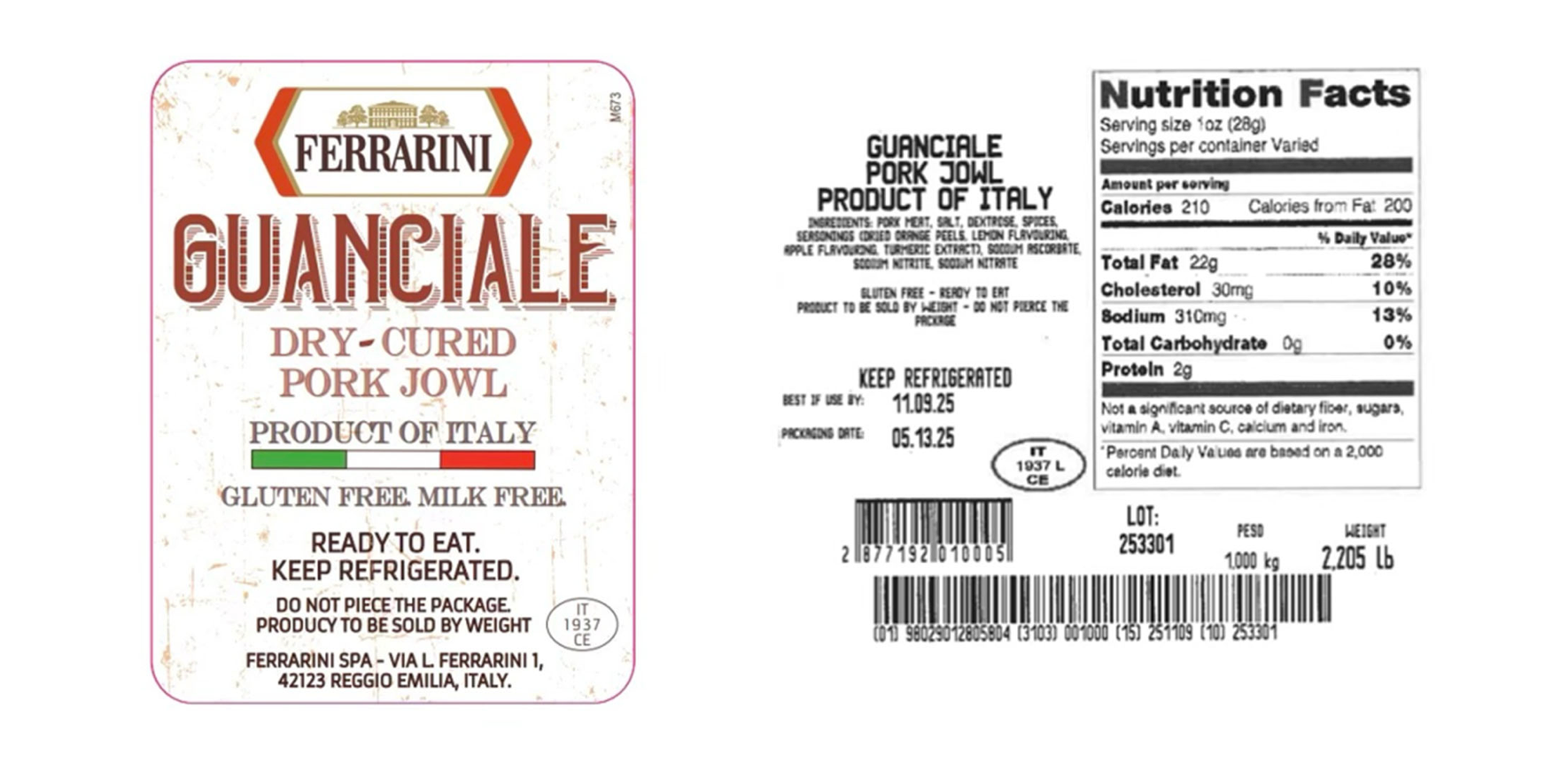
Prime Line Distributors Inc. of Fort Lauderdale, FL., and Ferrarini USA Inc. of Hoboken, NJ, are recalling 1,513 pounds of imported ready-to-eat (RTE) pork products that may be adulterated with Listeria monocytogenes, the USDA’s Food Safety and Inspection Service (FSIS) announced today.
The imported RTE dry-cured pork jowl (“guanciale”) products were produced at Est. 1937L Bome SRL in Italy on May 21, 2026, and imported into the U.S. on various dates within July 2026. The following products are subject to recall:
Prime Line Distributors, Inc.:
Various weight cardboard cases containing two pieces of individually vacuumed packed “PRIME LINE DISTRIBUTORS, INC. GUANCIALE PORK JOWL PRODUCT OF ITALY” with “LOT: 263311US” and “BEST IF USE BY DATE: 05.16.27” printed on the label.Various weight individually vacuumed packaged “GUANCIALE PORK JOWL PRODUCT OF ITALY” with “LOT: 263311US” and “BEST IF USE BY: 05.16.27” printed on the label. The product has an additional label with “DOK GUANCIALE” on the packaging.
Ferrarini USA, Inc.:
Various weight cardboard cases containing two pieces of individually vacuumed packed “GUANCIALE PORK JOWL PRODUCT OF ITALY” with “LOT: 263311US” and “BEST IF USE BY DATE: 05.16.27” printed on the label.Various weight individually vacuumed packaged “FERRARINI GUANCIALE DRY-CURED PORK JOWL” with “LOT: 263311US” and “BEST IF USE BY DATE: 05.16.27” printed on the label.
The products subject to recall bear establishment number “IT 1937 L CE” inside the Italian mark of inspection or printed on the case label. The Prime Line Distributors Inc. items were shipped to food service and retail locations in Florida. The Ferrarini USA Inc. items were shipped to distributors and food service locations in California, Florida, Idaho, Illinois, Michigan, New Jersey, New York and Texas.
The problem was discovered during routine import reinspection testing when a product saple confirmed positive for Listeria monocytogenes.
There have been no confirmed reports of illness due to consumption of these products. Anyone concerned about an illness should contact a healthcare provider.
About Listeria infections
Food contaminated with Listeria monocytogenes may not look, smell or taste spoiled but can still cause serious and sometimes life-threatening infections. Anyone who has eaten any recalled product and developed symptoms of Listeria infection should seek medical treatment and tell their doctors about the possible Listeria exposure.
Also, anyone who has eaten any of the recalled products should monitor themselves for symptoms during the coming weeks because it can take up to 70 days after exposure to Listeria for symptoms of listeriosis to develop.
Symptoms of Listeria infection can include vomiting, nausea, persistent fever, muscle aches, severe headache, and neck stiffness. Specific laboratory tests are required to diagnose Listeria infections, which can mimic other illnesses.
Pregnant women, the elderly, young children, and people such as cancer patients who have weakened immune systems are particularly at risk of serious illnesses, life-threatening infections, other complications and death. Although infected pregnant women may experience only mild, flu-like symptoms, their infections can lead to premature delivery, infection of the newborn, or even stillbirth.