
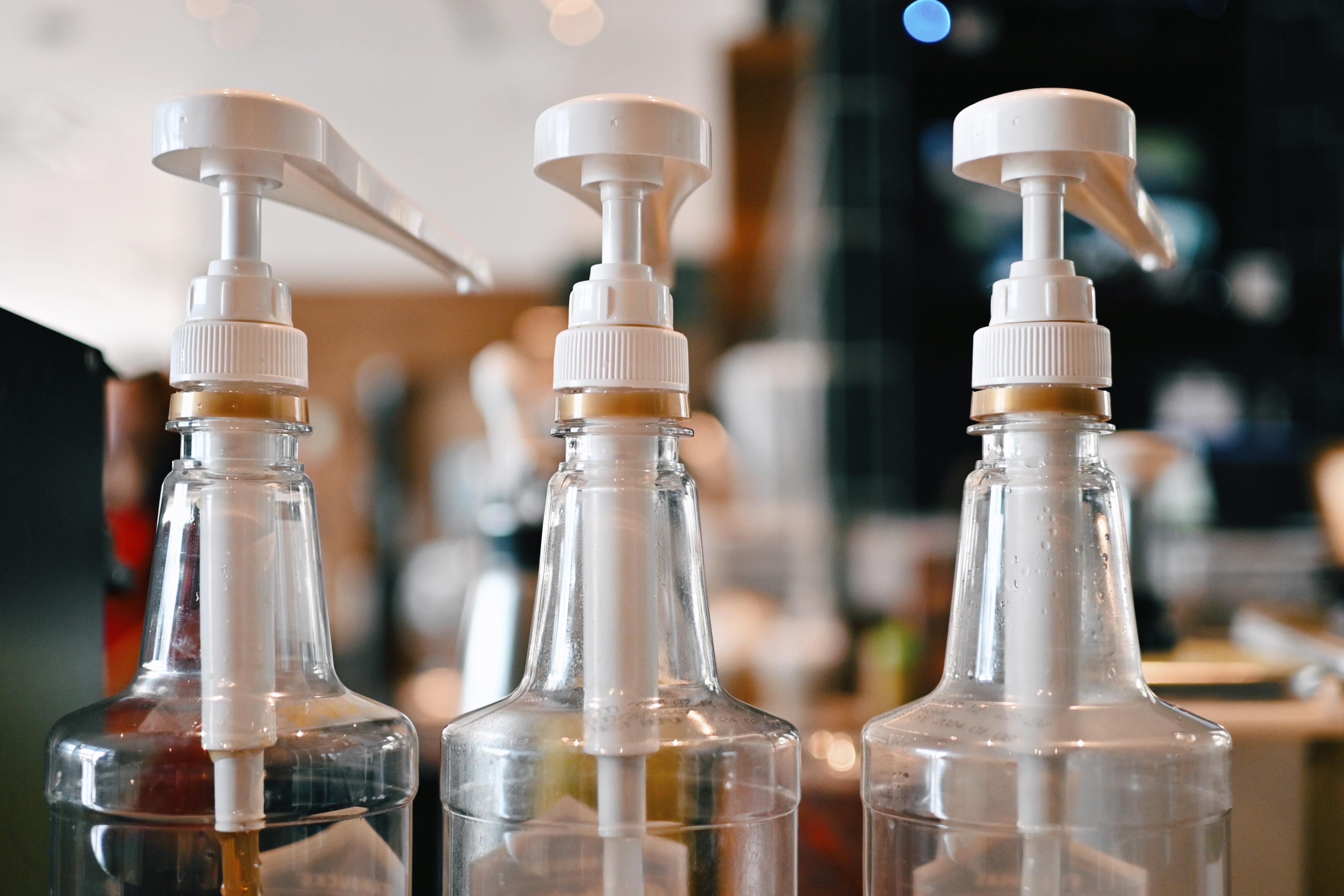
According to some coffee shop owners, customers now care more than ever whether the syrups are made in-house | Shutterstock
In a TikTok video with over 82,000 likes, the person behind the camera zooms into the shelves at a Pennsylvania coffee shop, three rows stacked with an array of Torani syrups in flavors like blueberry, brown-sugar cinnamon, English toffee, and salted caramel. “I just know my latte isn’t going to be good,” the caption reads. Across social media, similar sentiments appear. “If I see these at a cafe, I’m walking out immediately,” says one tweet, co-signed by many commenters. In a multipart video series, another creator documents her journey of replacing all of her Torani syrups with ones from small businesses instead. Last year, the niche food newsletter Unsnackable published what was described as a “Torani tirade.”
It’s not just a Torani problem, though the brand — by virtue of its market dominance — tends to get the most flack on social media. While some people seem to prefer competitor Monin, it, too, draws backlash over allegations of tasting “like chemicals.” The problem, for some drinkers of dessert-like specialty beverages, is premade syrups across the board.
For a certain sect of consumers, they’ve become a coffee shop red flag, a sign that a so-called “specialty” establishment asking them to fork over $8 plus tip for a latte is unfairly cutting corners when it comes to quality or craft. For these consumers, mass-market syrups now symbolize exactly that: They’re synonymous with coffee chains and corporations, the kind of impersonal institutions that many people are trying to get away from when they patronize a small business. The flip side: For independently owned coffee shops across the country, house-made syrup now represents a major opportunity.
When Carrie and Dennis Medina first envisioned their coffee shop, Room Service, in Ventura, California, they thought they would take an approach similar to the one at Sightglass Coffee, where they’d both gotten their start. “Very purist, with no syrups, no specialty drinks,” Dennis says. They imagined eight kinds of pour-over coffee and an emphasis on single-origin beans, since the couple also runs a roastery. “We said we’re never gonna do cream tops; we’re never gonna do these crazy drinks,” Carrie says. But in the first week alone, every customer was asking for them.
Now, Room Service offers 10 to 12 different syrups at any given time (and six different cream tops), all of them made in-house. It offers drinks such as a cinnamon roll latte topped with a cinnamon roll, and a honey cornbread latte with an ube cream top. “I hear that question all the time,” Dennis says. “‘Hey, do you guys make your syrups in-house?’” To him, a shop that isn’t trying to do at least the basics — like vanilla — in-house is “falling behind what the times are pushing for.”
The demand for syrups and other embellishments is so intense that the Medinas have brought on a full-time prep person who works exclusively on “all these things that we do in-house that make us special,” Carrie says. Room Service’s PSL, for example, starts with kabocha squash. It’s roasted, blended with spices such as cloves and cinnamon, and cooked into syrup, a process that takes two days. Echoing a sentiment that seems common among coffee shop owners right now, Carrie describes their current approach as “not necessarily the coffee shop we wanted, but it’s more like the coffee shop we have to be.” And if the market demands syrups and cream tops, then the Medinas wanted to ensure that the intention and emphasis on quality that they applied to their coffee beans also carried over.
In 2025, Michael Smith opened Trust Coffee Co. in Bay Village, Ohio, taking over, remodeling, and rebranding an older coffee shop. He, like the Medinas, imagined a more “pour-over, third-wave” style establishment. “But I’ve been a business owner for a long time,” says Smith, who also runs a restaurant and a catering business. “I’ve realized over the years that your customers tell you more about who you are than who you actually think you are.” His customers, it turned out, wanted seasonal syrups in niche flavors like maple rosemary, caramelized banana, and strawberry rhubarb.
The purist is no longer coffee’s north star; the maximalist is.
We live in the era of what the New York Times has dubbed “hyperflavor,” in which familiar foods are deemed newly interesting by the addition of complex new flavor profiles: The concept of miso in a peanut butter or chocolate chip cookie is no longer truly novel, but banal. Naturally, coffee drinks have followed the same trend. Where a studied self-seriousness once applied primarily to pour-over coffee meant to be drunk black, the tide has turned that precision and craft toward the previously derided, sometimes frivolous category of the sweet-treat coffee drink. How specialty shops now approach these creations feels more akin to how a pastry chef might assemble a dessert, or how a bartender might build a complex cocktail. The purist is no longer coffee’s north star; the maximalist is.
Syrups like Monin, which the shop’s previous iteration used, “serve a purpose in the industry,” Smith says, but he wanted more control over the menu. The two full-time pastry chefs from Smith’s other businesses oversee the shop’s syrups. “It’s become such a huge thing,” he says: Every time Trust’s social media manager posts a new syrup, the line is out the door for a week. “It sets us apart,” he explains.
When Sabrina Kaylor opened the first location of Bizarre Coffee in Canton, Georgia in 2020, the shop used bottled syrups. She hadn’t worked in coffee prior, and she said that approach felt like the norm at the time. “It allowed us to hone our craft and learn what we were doing,” she says. Over time, Kaylor — who’s quite active on the company’s official social media platforms — noticed that the tenor of the conversation was changing: In the immediate post-COVID years, people were making more things at home and there was more pride to be gained in “scratch-made.” With her business becoming known for lattes in flavors such as blueberry, banana, and guava, Kaylor decided to shift toward more house-made syrups. Previously, her customers didn’t ask about their sourcing, but now, they ask all the time.
As much as there is a sense of valor in the entirely from-scratch approach, Kaylor retains some skepticism about the current torrent of Torani and Monin backlash. Today, 90 percent of Bizarre’s drinks use house-made syrups, though one of its best-selling drinks still relies on the bottled stuff; Bizarre’s menu is extensive and making everything in-house would be a significant investment of labor. On the part of coffee shops, “I think a lot of [the house-made syrup conversation] is marketing, quite honestly,” Kaylor says. As for the bandwagoning that is all the anti-Torani memes, “I think it’s part of consumer behavior,” she says. And that, she acknowledges, can be really “discouraging” for small business owners.
In a sense, that’s what the premade-versus-house-made-syrup conversation boils down to: the stand between small businesses and big ones. For more consumers, the economic and social conditions of the current moment have inspired increased skepticism toward the influence of corporations and private equity in the food and beverage world.
The Minnesota coffee shop Little Joy has become famous across social media for posting the recipes of its signature drinks in detailed DIY videos. It has since launched a membership program through which other coffee shop owners can purchase its recipes, scaled up for commercial usage; gain access to training videos; and sell its drinks without even needing to attribute them to Little Joy, though the ones that would like to can pin their use of Little Joy’s recipes to a Drink Finder map.
Yes, these might just be recipes for syrups and foams, but in an interview with Eater’s industry newsletter Pre Shift earlier this year, Little Joy owner Cody Larson described the system as a way to build solidarity among independent businesses. “The big coffee chains, they’re never gonna do house-made syrups, so I think that’s where independent shops can get a leg up,” he said. “Ultimately, the chains are our competition… If independent shops can, in any way possible, raise the bar across the board, that’s good for all independent shops, including us.”
It’s hard to look at the drinks coming out of specialty coffee shops today — fluffy with foam, flavored to emulate nuanced desserts like princess cake and tiramisu— and not think of the Starbucks Frappuccino. The combination of app-ordering and social media “hack” culture have mainstreamed super-elaborate beverage requests, allowing Starbucks and coffee chains like it to become purveyors of highly complicated customizable beverages, mainstreaming the mindset of the aforementioned “hyperflavor.”
When it comes to why consumers have moved away from the single-origin pour-over approach at shops like his, “my guess is that these are a lot of people who used to be Starbucks loyalists and they’re looking for something that’s more local,” Smith says. “It’s a trend across everything where people want local, and we’re able to provide what Starbucks did, but in a more high-quality, more local way.”
Intentionality is what people are gravitating towards, especially as prices rise. If consumers are spending so much on a drink that’s undeniably a luxury, then they want to know that every part of that drink has been made carefully. And if they’re going to make the trip to a new, independent shop, they want to know that the offerings there aren’t the ones they can get anywhere, made with easily attainable, big-brand flavorings. For small coffee shops, the key to success could be as simple as syrup.