This excerpt was originally published in Pre Shift, our newsletter for the hospitality industry. Subscribe for more first-person accounts, advice, and interviews.
Everyone needs a convenient, accessible place to socialize. But maintaining a cafe, bar, restaurant, or hybrid space that fits the bill has its challenges. In this three-part series, we’re partnering with Spectrum Business to put a spotlight on third spaces and how their operators make them work.
Something I’ve noticed about third spaces—loosely defined as accessible community hubs—is that they tend to take a hybrid approach, like all-day cafes or bars centering an activity, whether it’s playing cards or line dancing. For operators, retaining regulars this way is obviously a win. But as Eater editor Nick Mancall-Bitel wrote in his piece about category-defying restaurants, maintaining the community feel also requires “negotiat[ing] their spaces and offerings with their customers.” Will Mester, from Baltimore’s The Wren, is quoted in that piece saying that “you have to turn it over to the public at some point, see what it does, and then see how you can succeed with it.”
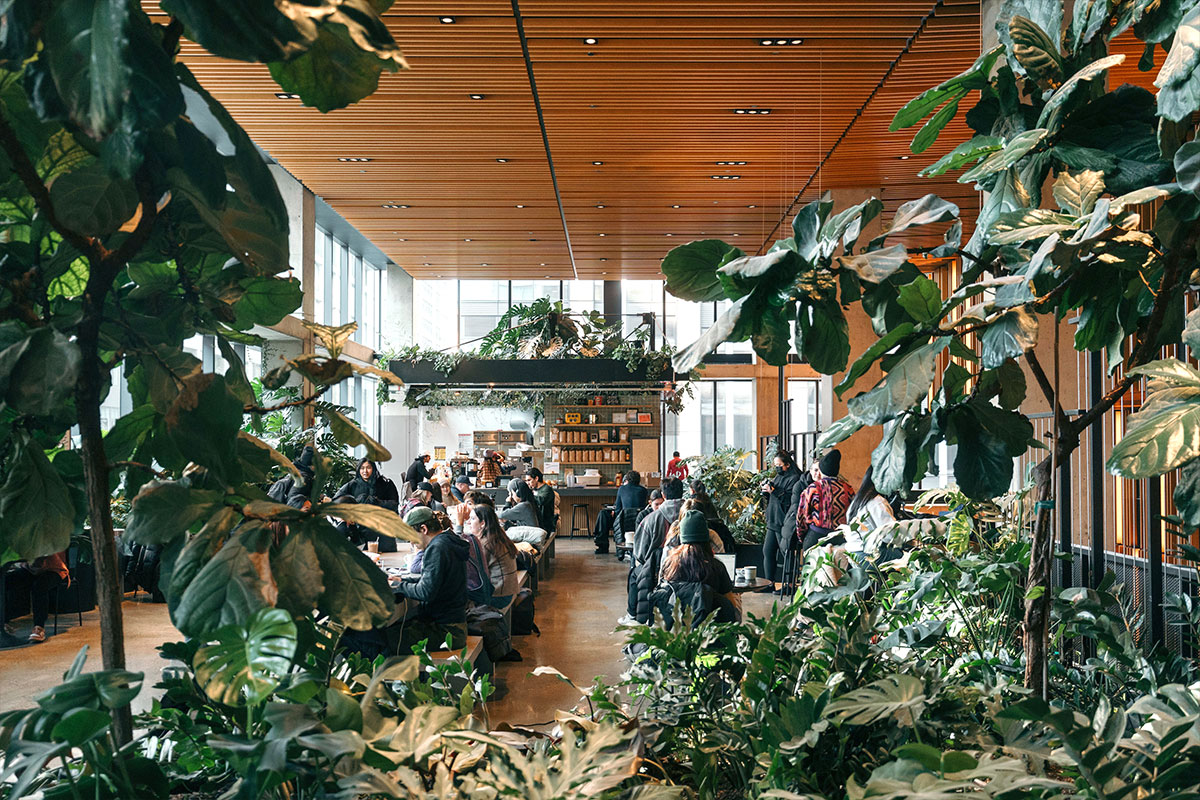
I was reminded of that when chatting with Joeleen Ng, who operates Bivy in Brooklyn and Georgie’s in Manhattan, two cafes in New York climbing gyms that have thrived off of adaptation. Ng took over Bivy, which caters to climbers on the roof of Vital Brooklyn, with little hospitality experience, figuring out how to prep at a high volume and how to manage a team along the way. When she opened Georgie’s a few years later, she hadn’t anticipated how the cafe would become so important to non-climbers; now, after it’s become a popular remote working spot shared on TikTok, she and the team continue to experiment with making the all-day format the best that it can be. I chatted with Ng about the balance between being a reliable spot for people glued to their laptops and being a gathering place for the community.
How did you start operating a cafe in a gym?
I started climbing at the gym a little bit after it opened in 2021. I was spending a lot of time there, and I was working in corporate at the time. I was doing pharmaceutical advertising, so, completely different. Post-pandemic, I was not really sure what I wanted to be doing with my life.
I had started cooking and baking a lot during the pandemic, experimenting with recipes. I first did a pop-up in Vital during one of their community days; they’re really good with all the ways that they are able to touch the community and create outlets for people. I did a few pop-ups, and after the gym’s first year, the original operator of the Bivy space decided not to continue, so they had a sign up in the window saying, “If anyone is interested in operating this space, send us an email.” I sent a picture to my partner and was like, “Do you think I could do something like this?” He was like, “Just try!” So I did.
I pitched an idea for the cafe space, and for some reason, they picked me, with very little experience. From there, it was just a whirlwind of learning. Getting set up without any background and trying to learn all of these things was a challenge. It was a little bit of a rough first year, but we somehow survived, and it did well enough that I think when they were getting ready to open [the gym in] LES, they knew they’d have a cafe space there and they asked me if I’d be interested in doing that as well. That was an exciting opportunity for me to be able to get involved from the start and to have some say in how the space is built out and all that.
Without much of a hospitality background, how did you learn how to operate your own cafe?
Unfortunately, it was a lot on the fly. When we first opened, it was just me working back there, and it got to the point where I was like, “This is not sustainable; I can’t do this on my own.” So I hired three people at first, but then I was like, “Oh, now I have to come up with the processes to make sure everything stays as consistent as possible,” and “Oh, now we’re going through five times as many sandwiches, so now we have to keep up with that production and prep.” It was a lot of realizing there were [more and more things I] had to do.
I used to work random waitressing and catering jobs in college, so I reached out to some old managers, too. A lot of what I was talking to old bosses about was managing a staff. I had never worked with so many people. When I was in corporate, I had one person reporting to me, so now to have a team of 15, 20, it felt very different. It added a bit more complexity that so many of our employees started off as climbers before wanting to work at the cafe. So everyone has this level of comfort and familiarity with the space that, now, when making it a work environment, you have to separate your relationship as climbers and friends versus an employee-employer relationship.
For me, a lot of the difficulty was letting go of some control, realizing that I can’t do everything myself. But also at the same time, [to let go, I had to] come up with the standards and procedures to make sure things can be as consistent as possible. Thankfully by the time we got to open Georgie’s, it had been two and a half years of Bivy, so I had a better framework of how I wanted things to run, and it was easier to get started.
Did the gym have stipulations about how it had to go?
They are great partners in that they give me free reign in terms of what to serve and how we want to do it. We have a management agreement with them, so we pay out a portion of what we make every month as our license fee, but with that, there’s a lot of freedom in how we run things.
Georgie’s, your second cafe, is on the Lower East Side, very close to Chinatown. Did the neighborhood factor into the menu?
Definitely. I grew up in Long Island, but we would come out [to Manhattan Chinatown] every Sunday for church, and we’d pick up our grandma to stay with us. She lived a 10-minute walk from the gym. I spent a lot of time over there. So I knew I wanted to make it a kind of space that was an homage to the neighborhood and the area I remember growing up. We source the pastries from [Manna One,] a bakery that I went to every single week growing up. A lot of the Hong Kong [menu items] are an ode to my grandma, who immigrated from there in the ’60s. I was very, very excited to get to introduce people to some Hong Kong-ish cuisines.
There’s a stereotype of a climber—like a white, granola-type person—but it’s obviously a diverse sport. Do you think about Georgie’s role in that at the gym? Are there people who come in for the pastries and drinks and then also get an introduction to climbing?
It was really interesting coming from Bivy, because Bivy is only open to climbers, and it serves gym folks. I thought Georgie’s would be like that, but then [we were featured on] a couple of TikToks, and we blew up.
Now, most of our customers are not climbers. It’s really funny to watch from behind the counter while people are waiting for their drinks, and they look over the railing and you see them pointing, like, “Oh, wow! Look at those guys!” It’s really cool to be able to introduce people to that community. But sometimes people don’t even realize that there’s a gym underneath.
They’re so locked in!
Yeah, a lot of people are glued to their laptops. But we’re trying to think of ways to get people to sign up for a yoga class or try the gym or something, just because I feel like there could be a lot of synergy.
You’re also operating as an all-day space, with coffee and pastries in the morning, and beer in the evening. Do you have any strategies for that day-to-night transition?
We’re still figuring it out, honestly. I am constantly surprised by how long and late people will work. We’re trying to get a handle on our bar menu and how we want to roll out. When we first opened, I had an idea for draft cocktails and a low-maintenance bar situation. I still want to do that, but the vibe of the space has taken on this whole work-from-home or study spot feeling, which continues on until 8 p.m. or later. People are hanging out on their laptops, which is not ideal for a bar situation, where you want people to be chatting and socializing. So we’re still trying to figure that out.
And maybe that’s where events come in. Can you tell me about the ones that Georgie’s hosts?
We do small business markets, pop-up events, trivia. CPG brands that are starting out do samplings in the space, too. An old friend is one of the founders of Green Tile Social Club, and cultural events like mahjong nights are important to me because it’s a way to get back to the culture and introduce people to it as well.
I knew when we opened that I wanted it to be a gathering space. I don’t think there’s any cafe in lower Manhattan that has as much space as we do. For me, it was really important to use it well [and to be a] good steward of the space. I also wanted to create opportunities for small businesses and people trying to get their footing—like how I got my start—to do the same.
This interview has been edited and condensed.