
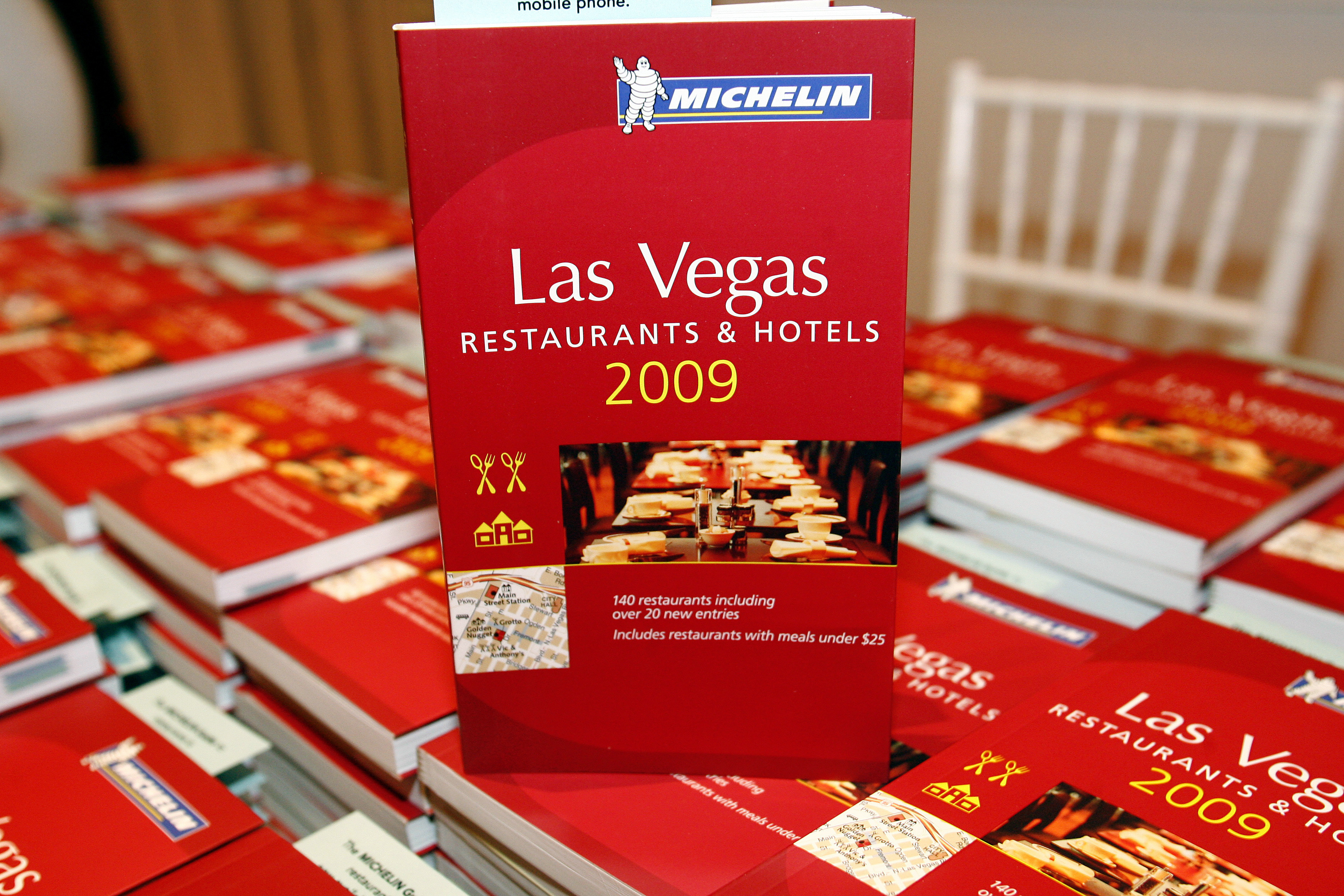
Books on display at the Michelin 2009 Las Vegas guide launch party at the Wynn Resort & Casino in Las Vegas. | Chris Farina/Corbis via Getty Images
There’s arguably no more intense and fascinating restaurant city than Las Vegas. In terms of pure volume of sales, it has no equal, perhaps anywhere in the world. The city also knows how to put on a show, offering culinary spectacle at some of the nation’s greatest restaurants. This combination of money and glitz is ripe for awards-conferring organizations like Michelin.
The last time the tire company awarded stars in the city, Bobby Flay’s Mesa Grill and Nobu inside the now-closed Hard Rock Casino held stars. That was in 2009. Then the guide left Sin City and didn’t return for 17 years. Michelin’s new Southwest guide — to be released later this year — will correct that long, notable absence.
Sign up for the Kang Town newsletter
This story was inspired by my newsletter, where I shared my predictions for which Southwest restaurants will get Michelin stars in 2026. Sign up here to get my latest intel and insights.
“The Michelin Guide launched in Las Vegas in 2008, in the wake of the global economic crisis,” a Michelin spokesperson said this week. “As a result, the Guide chose to remove the city from its list of destinations. This year, the time proved to be right to launch a regional edition for the Southwest, inclusive of Las Vegas.”
Michelin could change the dynamic on the Strip by reinforcing the biggest names in town like José Andrés and the late Joël Robuchon. It could also create competition among the mega resorts, as they compete for the most stars. You can imagine the pylons touting that “Caesars Palace has six Michelin-starred restaurants” or that “The Venetian has the most Michelin-starred restaurants in Vegas.”
It could also allow restaurants other than steakhouses to compete for the big, expense-account dinners that surround any major convention. (Nothing says “balling out” to clients better than dinner at a Michelin-starred omakase.) Whether they end up earning stars or not, placement in the guide could also lift off-Strip restaurants like Sparrow + Wolf — a reasonably priced, polished fine dining restaurant in Chinatown — cementing the greater city as a regional destination.
“[This] is a huge win for all of us here,” says chef Brian Howard, who owns Sparrow + Wolf. “I’m really excited for the city and to show that our culinary scene has matured over the years. When you peel the onion back, there’s some real serious cooking happening in this town.”
What do you think?
How will Michelin stars impact Vegas? Is the Michelin guide’s business model ethical? Let me know your thoughts by sending a message directly to kangtown@eater.com.
But Michelin’s return to Vegas isn’t just important for the city. It also marks the near-completion of the guide’s expansion across the U.S. and the total success of its pay-to-play model.
After leaving Vegas (and LA) in the late 2000s, Michelin started to expand again in 2017, adding a guide to D.C. alongside its bases in Chicago, San Francisco, and New York. Since then, it’s spread across the lower 48 states. Including guides to Canada and Mexico, North America is now about as well-covered as Michelin’s home base of Europe.
Michelin’s expansion has been driven by destination marketing organizations. Destination Marketing Organizations (DMOs), essentially tourism boards and visitors bureaus, use public money from hotel and local taxes in an effort to spur economic development. It’s typically a good trade-off. Alongside other projects, these organizations pay to attract Michelin guides; for instance, in Florida, DMOs from Miami, Orlando, and Tampa pooled an estimated $1.5 million for guides between 2022 and 2024. In Texas, Fort Worth, Dallas, Houston, San Antonio, and Austin cobbled together $2.7 million for guides in 2024. Along with publicity for a city’s food scene, Michelin collaborates on award reveal ceremonies, food festivals, and other events that bring tourism revenue to a city and participating restaurants.
“[That] revenue contributes to financial or editorial investment, which is quite huge,” Gwendal Poullennec, formerly international director of the Michelin guide and now senior vice president of lifestyle at the company, told Bon Appétit in 2024. “In terms of full-time employees, paying the bills, salaries, travel expenses, and cars — my editorial expenses are bigger than some of the largest newspapers in the world.”
The guide’s return to Vegas could be read as a huge validation of impressive restaurants, evidence of an aggressive expansion strategy by Michelin, the Las Vegas Convention and Visitors Authority (the local DMO) increasingly relying on high-end culinary tourism to bring in visitors, or all of the above.
That pay-to-play model hasn’t turned off diners or restaurant owners. Michelin has won the global competition for fungible credibility, evidenced by the hundreds of shiny red placards hanging in restaurants (and the hundreds of thousands of page views garnered on Eater stories about Michelin over the years). In the same interview, Poullennec insisted the guide maintains its independence, not allowing deals with DMOs to influence its awards.
Why has the Michelin guide become so successful in America? It’s given out lots of accolades. Michelin has mostly shed its myopic focus on a handful of cuisines (expensive, European or Japanese-inflected). Bib Gourmand awards (for affordable dining) and the guide’s “inclusion” system (previously called Plates) for non-starred restaurants (which still get placards) have expanded the type and number of restaurants that might qualify in some way. Even stars seem a bit more accessible, as places like Mexican seafood stand Holbox in Los Angeles; casual pasta-and-wine spot Boia De in Miami; and San Francisco’s relatively affordable State Bird Provisions nab them.
The Michelin Guide adapted to America, and America adapted to the Michelin Guide. It’s a happy marriage, for now.
“The Michelin Guide’s priority is to establish where there is culinary potential and where there is a demand in terms of traffic, tourism, and all that,” Poullennec said in the same interview. “So between the Destination Marketing Organization and the Michelin Guide, I think the road map is pretty much aligned.” The Michelin Guide adapted to America, and America adapted to the Michelin Guide. It’s a fairly happy marriage, for now.
That doesn’t mean the guide will end up in every corner of the country. This week, a spokesperson said the guide team looks for new areas to cover based on “destinations matching our demanding criteria.” Guide inspectors may not think every city or region that pays for a guide is worthy of tons of stars, while DMOs that represent areas outside of culinary centers like New York City, Chicago, and Washington D.C. may not be satisfied with a handful of winners.
Markets for guides may also fluctuate over time. The Michelin organization tends to start in new areas by awarding a few noteworthy restaurants that people would expect to receive stars; then, every year or so, it makes a splashy recognition, like three stars for Somni and Providence in LA last year or stars for three barbecue spots in Texas in 2024. Multiyear contracts for guide coverage allow cities to secure some guaranteed publicity while allowing Michelin room to renegotiate for more investment periodically.
The timing of Michelin’s Southwest guide is interesting. It arrives just as news reports everywhere declare the city’s dramatic drop in tourism — not unlike the fallout of the economic crisis in 2008 that originally pushed Michelin out of the city. It’s unclear what kind of deal Las Vegas’s well-financed tourism board may have negotiated now — neither Michelin nor the Las Vegas Convention and Visitors Authority commented on that aspect.
The guide may not dramatically transform Las Vegas’s economic fate and change the underlying issue of sky-high costs. However, it’s also becoming clear that the “downturn” may be more of a snap back to expected growth after rabid post-pandemic spending. Still, any momentum around one of Vegas’s true strengths — its dining scene — will count as a win for the city’s DMO.
Though the bulk of Howard’s menu at Sparrow + Wolf is a la carte, he does offer a $142, five-course chef’s tasting menu that falls in line with what Michelin likes to recognize. But he’s not chasing the star. “The Michelin Guide doesn’t define us. We’re consistently busy, and I’m happy my seats are full every night,” says Howard. “The accolades are nice and an honor, but we’re not going to change our direction.” He still thinks Sparrow + Wolf will get a star.