
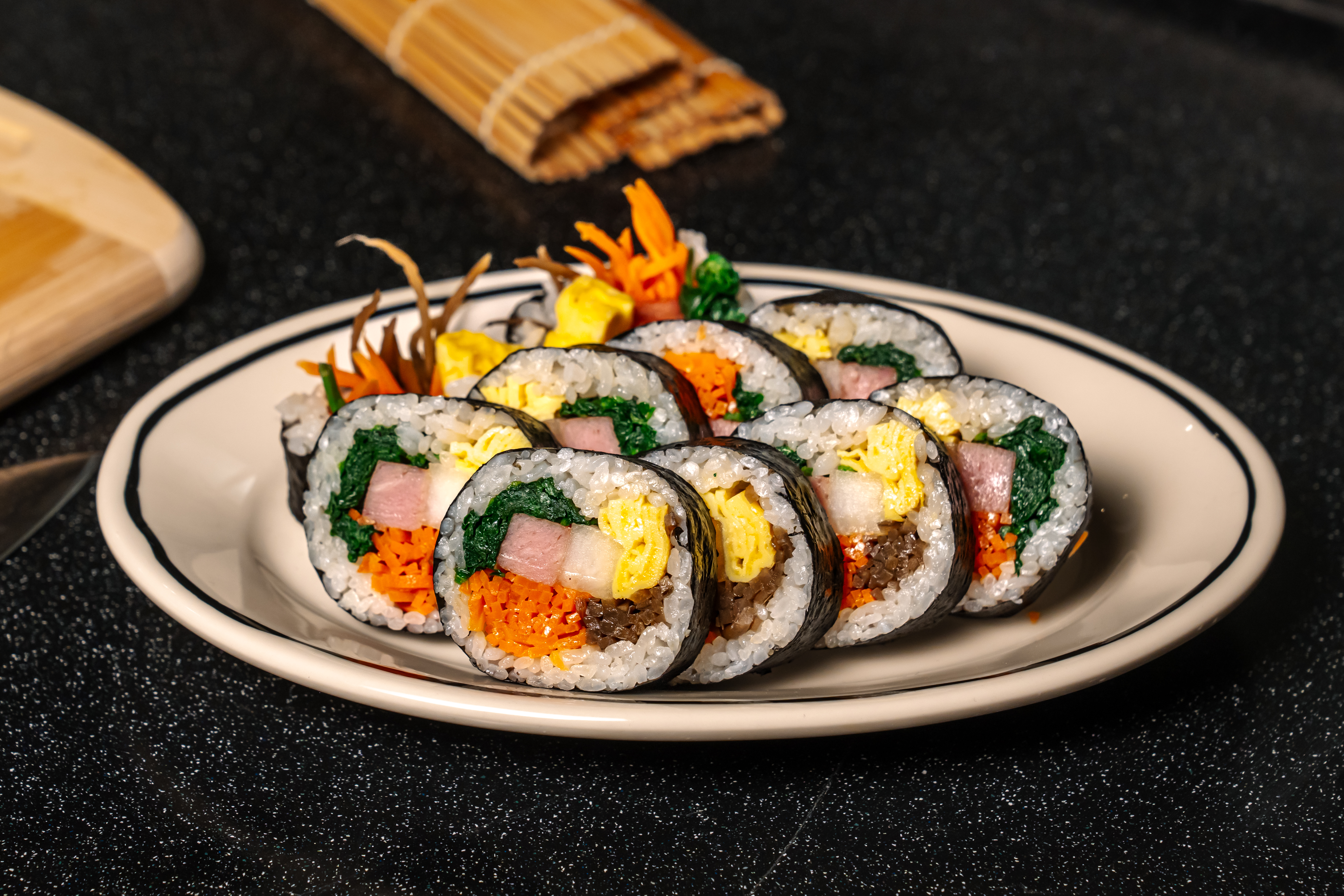
With the new pop-up TBD Gimbap, chef Jihan Lee is testing the market for gimbap in New York City | Jill Rittymanee/TBD Gimbap
On a personal level, gimbap came first for chef Jihan Lee, with his mom’s gimbap setting the standard. On a professional level, though, gimbap took a backseat to another seaweed-wrapped rice roll: sushi. After training at New York City’s two-Michelin-starred temple of sushi Masa, Lee and his business partners opened the Japanese hand roll bar Nami Nori in 2019. Even though they’d floated the idea of gimbap, also often romanized as kimbap, since day one, it didn’t feel like the right time.
The idea remained in the back of their heads. “As Nami Nori grows, eventually we’ll have a team that’s operating it,” Lee recalls thinking. “Then, we can really think about the concept of gimbap, because it’s still something very new to the [rest of the] world.” He wanted to make sure they could do it right, with restaurant business expertise behind them and the trust of diners. In mid-March — with Nami Nori now established enough to have expanded into Florida, New Jersey, and Virginia — Lee unveiled TBD Gimbap in Manhattan’s West Village, where he serves only gimbap. “No soy sauce required,” reads a sign in the space.
With more typical fillings like beef bulgogi and spicy carrots, but also a forthcoming slate of specials that draw on his Japanese training, Lee hopes to push the concept — and test the waters — of what constitutes gimbap. TBD, as its name might suggest, is technically a pop-up; Lee expects it’ll be open until at least May. Lee and his partners in Launchpad Hospitality are sussing out the market; of course diners wanted sushi, but now, how much do they want gimbap?
It’s not the first dedicated gimbap restaurant in the city; it follows in the footsteps of places like Kimbap Lab, which launched in NYC in 2014. And in March, Kim’s Kimbap also opened as the first United States outpost of a chain that’s operated in Korea since 1992, serving made-to-order rolls filled with ingredients like chicken tenders and spicy pork, though the rolls have been upsized into burrito-like portions for the American audience. The global boom of Korean culture made it the right time to expand to NYC, according to store owner John Kim. “K-food has more recognition than before: People can distinguish gimbap from sushi,” he says. “It’s an opportunity.” Even frozen gimbap is on the come-up: At Trader Joe’s, gimbap is a hot item every time it returns to the freezer shelves, thanks to TikTok fame.
By virtue of its appearance and its general format, gimbap has often been described in Western media as “Korea’s sushi.” Yes, at a glance, there are ingredients swaddled in short-grain rice and then rolled in a sheath of seaweed. Still, some might call this a lazy comparison, one that disregards the nuance in technique and expectations between the two dishes, as well as the cultural differences between Japan and Korea. (The question of which dish came first remains a tenuous one.) Now, with Korean cuisine having attained more stature globally, some chefs are advocating for a better understanding of gimbap, one that lets the dish stand on its own without comparison. (Even Trader Joe’s disaggregates the two.) “I just want to show that gimbap is different,” Lee says.
What makes good gimbap is variety. If sushi emphasizes the simplicity of rice and seasoned fish, gimbap explores the harmony of more ingredients, though these inclusions vary depending on the maker. For this reason, gimbap can be laborious. “I always want it to have something salty, something crunchy, and something in between,” says Jihee Kim, the chef and owner of Los Angeles’s Perilla, which she describes as a “reimagination” of Korean banchan through California produce. “I’m looking for textures: something crunchy, something fresh, and some pickled stuff for flavor,” she says, adding that the avocado in hers is more of a “California thing.”
In an attempt to dissuade customers from dipping her gimbap in soy sauce — she doesn’t think it fits with the way the fillings are seasoned — Jihee Kim serves it with a hot mustard sauce, though that’s a bit of a concession, too. “Some people, especially Americans, are looking for a lot of sauces,” she says. Perhaps more than sushi, gimbap is like a sandwich. At least, that’s how she associates it: as synonymous with childhood picnics as sandwiches and field trips might be to others, and with a similar level of variety.
For some people, the complicated relationship between Japan and Korea can make the comparisons between gimbap and sushi more frustrating. “When you take into account the history of Japan colonizing Korea — and having taken a lot from Korea, and absorbing it into its own culture — this idea of Korea constantly being subsumed by Japaneseness is pretty fraught and kind of tense,” says culture writer Giaae Kwon. Kwon has written significantly about gimbap, including a 2021 piece titled “Kimbap, Never ‘Korean Sushi,’” in which she describes gimbap as one of the “quintessentially nostalgic foods in Korean cuisine.” In recent years, this cultural tendency to juxtapose Korea and Japan has changed slightly as Korean food has increasingly entered the American zeitgeist, Kwon acknowledges.
For Kwon, it was Momofuku’s short-lived NYC restaurant Kawi that reshaped how she thought about gimbap, a dish she’d previously found “uninteresting.” At Kawi, the chef Eunjo Park made Korean food that Eater NY’s former restaurant critic Ryan Sutton described at the time as “stunning,” including gimbap with foie gras, short rib, or omelet and dried anchovy, offered with a side of trout roe and uni. In an email, Kwon described Park as having given gimbap “life” at Kawi. “Because she understands Korean food, she was really able to push boundaries in terms of what we might think of as gimbap,” Kwon says.
Kawi became a pandemic casualty in 2021, though Park continues to share her experiments on Instagram, proving how friendly the format is to experimentation: gimbap with galbi-style mushrooms wrapped in phyllo, then rolled with chives and pickled burdock; gimbap that riffs on Chinese tomato egg, with tomatoes confited in sesame oil; BLT gimbap, crunchy with bacon crumbles; gimbap with pan-fried Jimmy Nardello peppers.
At Super Peach, the LA restaurant that opened in October, gimbap has been the highest-selling dish on the menu, according to executive chef Nick Picciotto. It is, indeed, a call back to Kawi, where Picciotto also worked. “It’s something that we always wanted to bring back,” he says, though he notes that the gimbap at Kawi was “a little more high-end” than what they’re currently doing at Super Peach.
Despite the glowing reviews of Kawi’s gimbap, Picciotto recalls some pushback at the idea of selling gimbap for between $30 and $70. “We learned our lesson of the acceptable price that people are willing to pay, depending where our location was,” he says. Super Peach, which is in a mall, takes a more middle-of-the-road approach, with gimbap between $19 and $29. The best-sellers are the spicy bluefin tuna gimbap with avocado and crushed rice crackers, and the galbi-glazed beef gimbap with dill pickles and caramelized onions. “I’m really glad to bring that circle back [around] from Kawi,” Picciotto says.
For Lee, the motivation to open TBD somewhat mirrored the motivation behind opening Nami Nori. It made him sad, he says, that his friends and family struggled to eat at Masa, where lunch runs $495 per person. Eventually, what he started to see with Korean food was “like deja vu,” he says, referring to the rise of Korean fine dining in NYC. “I started thinking, Wow, Korean food is becoming unattainable.”
As much as Lee respected that work, he wanted to make food that people could eat once or twice a week. “I thought gimbap was the perfect business for that,” he says.