
By John Agbetsi
Every November, food safety advice follows a familiar script: thaw the bird properly, wash your hands, use a thermometer. That advice is sound, and I’ll repeat it below. But it leaves out two risks that rarely make the holiday headlines: the false comfort some cooks take from marinades and rubs, and the Salmonella that can ride into the kitchen in a jar of dried spice. Both deserve a place in the Thanksgiving conversation.
Thanksgiving became a national holiday in 1863, when Abraham Lincoln proclaimed a day of thanksgiving in the middle of the Civil War. Decades earlier, in her 1827 novel “Northwood,” Sarah Josepha Hale had already put a roast turkey at the center of the table. She couldn’t have known how much chemistry was sitting on that platter.
Why acid doesn’t make turkey safer
Some home cooks believe an acidic marinade of citrus, vinegar, wine, or buttermilk helps “clean” raw poultry. Turkey’s own chemistry works against that idea. Its muscle, especially the white breast meat, has a high buffering capacity, meaning it resists changes in pH. That muscle was built for bursts of intense activity that generate acid, so it is loaded with compounds that keep pH steady: structural myofibrillar proteins, inorganic phosphates, and the dipeptides anserine and carnosine. When acid is added, these buffers absorb the incoming hydrogen ions, and the meat’s pH stays close to neutral. That is exactly the range where Salmonella grows comfortably.
The lesson is simple: a marinade is a flavor step, not a safety step. The only thing that makes raw turkey safe is cooking it to an internal temperature of 165 degrees F, checked with a thermometer in the thickest part of the breast and the innermost part of the thigh.
Raw turkey’s Salmonella risk is not hypothetical. From 2017 to 2019, a multidrug-resistant strain of Salmonella Reading linked to raw turkey products sickened hundreds of people across dozens of states. Investigators found the strain throughout the turkey supply chain, from live birds to raw pet food.
Thaw it right
The CDC’s guidance is clear. In the refrigerator, allow about 24 hours for every 4 to 5 pounds. In cold water, seal the turkey in a leakproof bag, submerge it, and change the water every 30 minutes. In the microwave, follow the manufacturer’s instructions and cook the turkey immediately afterward. Never thaw a turkey on the counter.
The risk in aromatics and spices
Fresh aromatics carry their own risks. Onions have been at the center of major outbreaks. In 2020, CDC and FDA linked a Salmonella Newport outbreak to red onions that sickened more than 1,100 people in 48 states and more than 500 more in Canada. Keep raw onions, garlic, and herbs away from surfaces that held raw turkey, and take care when they go raw into sides and garnishes.
Dried spices are a quieter problem. Because they are low-moisture foods, we tend to think of them as shelf-stable and safe.Salmonella disagrees. It can survive in dry foods for months, and under that desiccation stress it switches on survival responses that can make it more tolerant of heat.
In 2009 and 2010, salami coated in contaminated black and red pepper was linked to Salmonella Montevideo infections that sickened 272 people in 44 states and the District of Columbia. Salmonella Senftenberg was also found in the pepper.
The problem often begins at the processing plant. Facilities that handle dry ingredients avoid water during cleaning, because moisture helps bacteria spread. But food residue and microscopic traces of moisture left on surfaces allow Salmonella to form dry-surface biofilms.
In a 2024 laboratory study published in Applied and Environmental Microbiology, Lin and colleagues found that these dry biofilms are far harder to kill than the wet biofilms most sanitation programs are designed around. Seventy percent isopropyl alcohol, a common waterless sanitizer, killed roughly 99.99 percent of Salmonella in a wet biofilm but only about 97 percent in a dry one. The dried cells were wrapped in dense protective capsules, and while most had gone dormant, a subset was still expressing genes linked to stress defense and virulence. Dormant, in other words, may not mean harmless.
What needs to change
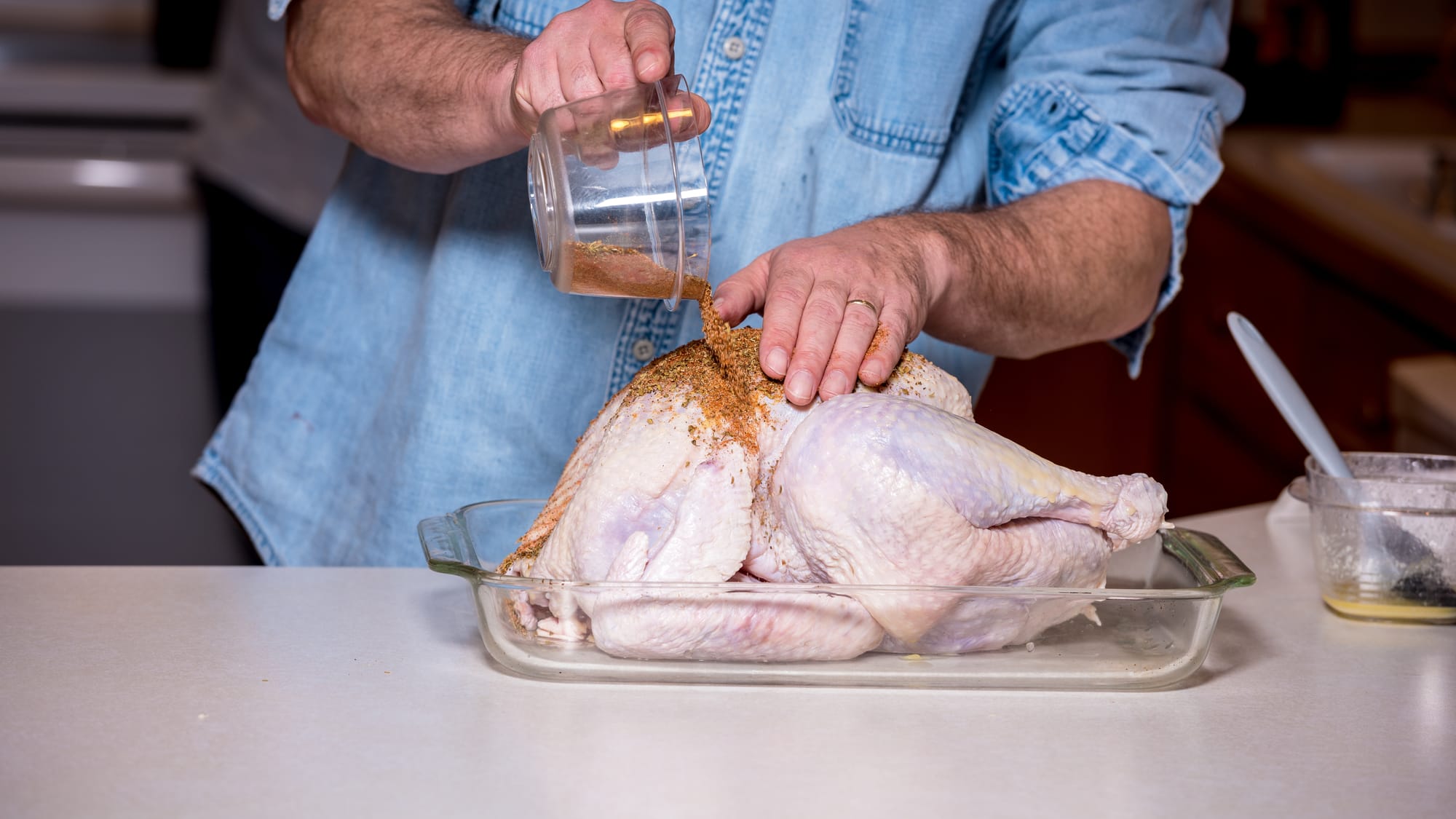
For home cooks, the fixes are easy. Treat marinades and rubs as flavor, not protection. Salt, garlic, and thyme have antimicrobial properties in the lab, but at the amounts used on a turkey they won’t reliably kill Salmonella, which is notoriously good at surviving dry, salty conditions. Add dry rubs and spices before cooking, so the same heat that makes the turkey safe also treats the seasoning, rather than sprinkling them on finished food. And keep raw aromatics away from ready-to-eat dishes.
For industry, the stakes are higher. Many spice processors already apply validated kill steps such as steam treatment or irradiation to the spices themselves. What lags is sanitation built for dry environments. Processors should treat dry-surface biofilms as a known hazard, not a theoretical one, with environmental monitoring designed to find Salmonella on dry surfaces and sanitizers validated against dry biofilms rather than wet ones.
Consumers can’t see or wash away bacteria in a jar of ground pepper. That responsibility belongs upstream.
This Thanksgiving, trust your thermometer, respect your spice rack, and remember that the turkey’s chemistry is not on your side.
References
Lin, Z., Liang, Z., He, S., Chin, F. W. L., Huang, D., Hong, Y., Wang, X., & Li, D. (2024). Salmonella dry surface biofilm: morphology, single-cell landscape, and sanitization. Applied and environmental microbiology, 90(11), e0162324. https://doi.org/10.1128/aem.01623-24
Public Health Agency of Canada. (2020). Outbreak of Salmonella infections linked to red onions imported from the United States (final update).
CDC. (2020). Salmonella Outbreak Linked to Onions (final update, October 8, 2020). archive.cdc.gov/www_cdc_gov/salmonella/newport-07-20. This page reports 1,127 people infected with the outbreak strain from 48 states.
Centers for Disease Control and Prevention (CDC) (2010). Salmonella montevideo infections associated with salami products made with contaminated imported black and red pepper — United States, July 2009-April 2010. MMWR. Morbidity and mortality weekly report, 59(50), 1647–1650.
Finn, S., Condell, O., McClure, P., Amézquita, A., & Fanning, S. (2013). Mechanisms of survival, responses and sources of Salmonella in low-moisture environments. Frontiers in microbiology, 4, 331. https://doi.org/10.3389/fmicb.2013.00331
Burt S. (2004). Essential oils: their antibacterial properties and potential applications in foods–a review. International journal of food microbiology, 94(3), 223–253. https://doi.org/10.1016/j.ijfoodmicro.2004.03.022
Baldi, G., Soglia, F., Laghi, L., Meluzzi, A., & Petracci, M. (2021). The role of histidine dipeptides on postmortem acidification of broiler muscles with different energy metabolism. Poultry science, 100(2), 1299–1307. https://doi.org/10.1016/j.psj.2020.11.032
About the author: John Agbetsi is a PhD student at New Mexico State University, where he uses omics technologies to study dry-surface biofilms in low-moisture foods at the New Mexico Food Safety Lab. He spent five years as a quality control officer at Hans Peter Welder Fresh and Dry Limited, where he saw the sanitation challenges of dry food processing from both the plant floor and the lab bench.