
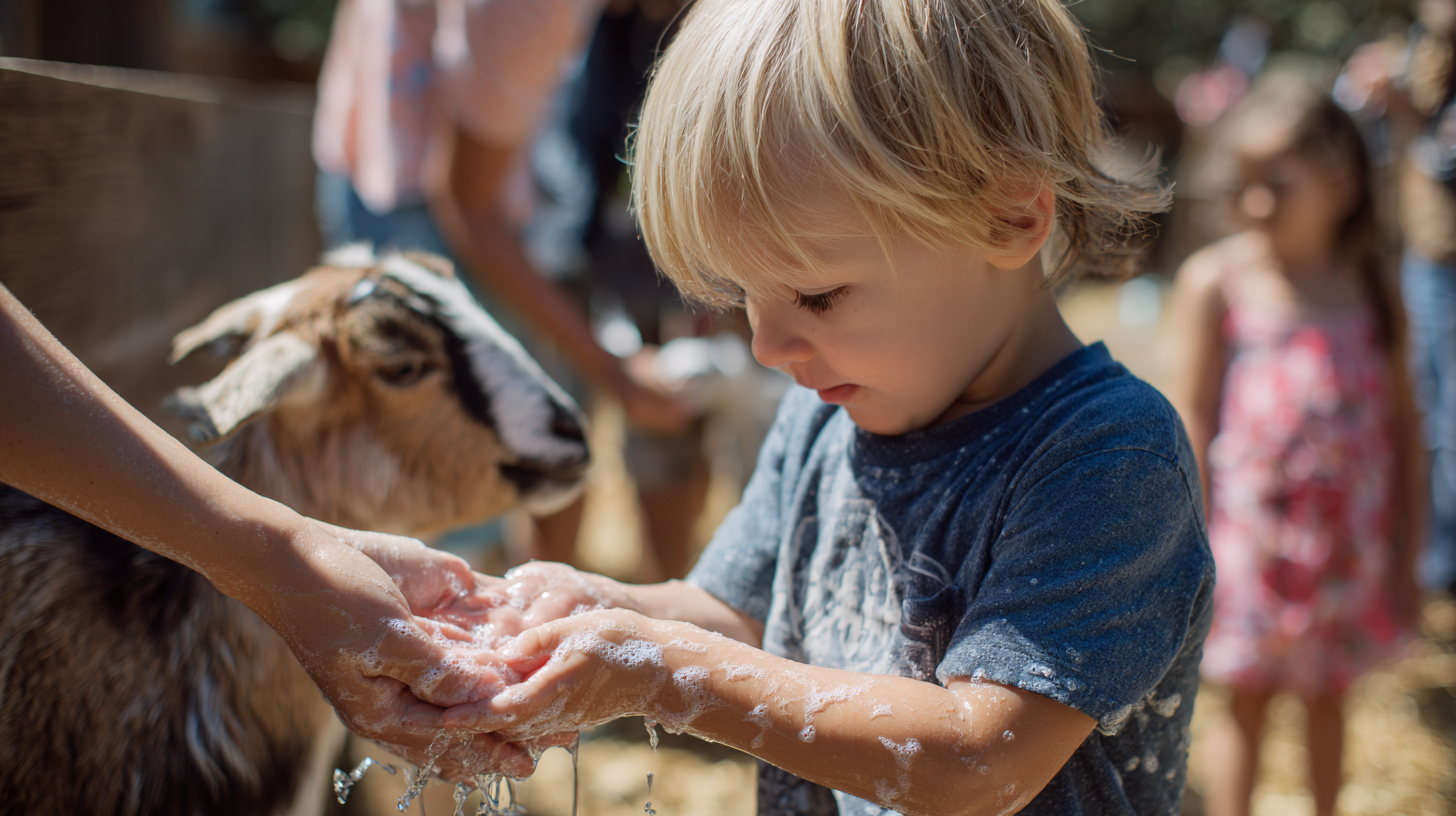
I have been asking the same question in print since 2004. In an op-ed called “E. coli and the Fair,” I asked, “So what do we do? Banish state and county fairs? Eliminate Petting Zoos?” and answered myself in three words: “Of course not.” In 2012 the headline was “Ban Petting Zoos?” In 2015, after a toddler died following a small-town Maine fair, it was “As I have said before – is it time to ban petting zoos?” In 2019, after a two-year-old died following the San Diego County Fair, it was “Seriously, time to ban petting zoos?”
A question asked four times over twenty-two years is not really a question anymore. It is a way of not answering. This week three health departments in three states opened investigations into E. coli infections tied to animal attractions at fall events. So here is my answer.
This week, in three states
At Bengtson’s Pumpkin Farm in Homer Glen, Illinois, five people with confirmed Shiga toxin-producing E. coli (STEC), ages 4 to 38, four of them hospitalized. The petting zoo closed on October 23; the rest of the farm stayed open, and more than 200 visitors have filled out the county’s symptom survey. At Brookshire Farms in San Luis Obispo, California, five confirmed cases and an exposure window of October 16 through 26; the farm closed itself down. And in Dallas, the county is investigating up to seven possible cases in children, some treated in intensive care, and whether they trace to the petting zoo at the State Fair of Texas. The county is not yet calling it an outbreak.
I laid out what we know about each investigation yesterday, and this morning I posted twenty-five years of outbreaks just like them and the prevention playbook that everyone already has. This post is about something else: what I have been telling fairs, legislators and parents for two decades, what came of it, and what I think we should do now.
What I said, and when
Year
Post
What I called for
2004
Warning signs at entrances stressing the risk to small children, hand-washing stations, no food near animals, better ventilation and testing of display animals. Ban petting zoos? “Of course not.”
2005
Lightning Strikes the Same Spot Twice
After the Florida fair outbreaks: the same simple, inexpensive precautions, and signs telling parents why hand-washing matters.
2005
Marler Clark Calls for Legislation to Protect Visitors at Petting Zoos
Laws, not guidelines, in every state: signage and health warnings, hand-washing stations, and exhibits designed to keep people away from manure. I said then it “might seem extreme.”
2005
Praise for North Carolina Petting Zoo Guidelines – But Are Guidelines Enough?
Good guidelines, but only guidelines. I held up Pennsylvania’s 2002 law – hand-washing facilities and posted risk warnings, required of everyone – as the model.
2012
After a second North Carolina State Fair outbreak and a second task force: the guidelines are not working.
2015
As I have said before – is it time to ban petting zoos?
After a child’s death in Maine: stop blaming families for not washing; consider vaccinating or testing animals; or ban.
2015
We Need “A Petting Zoo Preservation Act”
Walked through Pennsylvania’s law, North Carolina’s Aedin’s Law and its rules, and Washington’s rule. Concluded that petting zoos would not be banned, and perhaps should not be – but need enforceable rules. Promised a Model Act.
2019
Seriously, time to ban petting zoos?
After the San Diego County Fair death, I re-ran the 2012 op-ed and asked readers what should be done.
2026
Maricopa County’s Final Report on the 2025 Arizona State Fair
18 sick, 11 hospitalized, six with HUS. Hand sanitizer was not enough, and the Arizona bill requiring hand-washing, access control and warning signs died.
Read in a row, those posts tell a story I am not especially proud of. I have been right about the risk for twenty-two years and mostly wrong about how much signs and guidelines would fix it.
What two decades taught me
Signs alone have never been enough – but the right sign helps. Every post on that list asked for signs. The State Fair of Texas’s old Children’s Barnyard relied on hand-sanitizing gel and signs before the fair scrapped it in the mid-2000s. A sign that says “Please wash your hands” is wallpaper. The Compendium found that awareness of the risk actually protected visitors at the 2004 North Carolina State Fair. The lesson is that a sign has to tell parents what is at stake, in plain words and in the languages families at that fair speak: animals in this area can carry E. coli, it can cause kidney failure in young children, and soap and water – not sanitizer – is how you protect them.
Guidelines are not requirements. The CDC issued recommendations in 2001. State public health veterinarians have published the Compendium since 2005. As I wrote this morning, there is still no federal law on disease risk where animals and the public mix, and most states rely on voluntary guidance. Twenty-five years of outbreaks is the result of voluntary.
Laws work only as well as their weakest line. North Carolina did the most after its 2004 outbreak – Aedin’s Law, a permit and inspection for every animal exhibition at a sanctioned fair, and detailed rules that put soap-and-water stations within ten feet of exhibit exits and kept sanitizer dispensers out of the transition areas. It still had outbreaks in 2011 and 2012. Washington’s rule lets operators substitute an “alternative hand sanitizing method” approved by the local health officer. That is the loophole the Arizona State Fair walked through in 2025, and the Big Fresno Fair walked through in 2005.
The market is already banning petting zoos – one sick child at a time. Texas scrapped its fair petting zoo when insurers raised rates. By 2015, North Carolina Health News was reporting that petting zoos were becoming a thing of the past at the N.C. State Fair. After last year, the Arizona State Fair dropped its petting zoo for 2026 and the Maricopa County Fair dropped direct animal contact. Each of those decisions came after children were hurt. A ban by lawsuit and insurance premium is the most expensive, least predictable ban there is.
I was wrong about testing. In 2004 and again in 2015 I suggested testing animals before they arrive. The veterinarians have persuaded me that a negative test means little: these animals shed intermittently, and in San Diego in 2019 every animal and environmental sample came back negative after a child had died. Prevention has to assume every goat, calf and lamb is positive.
So – should we ban petting zoos?
Not all of them. I said in 2015 that petting zoos were not going to be banned and perhaps should not be, and I still believe a child who learns where food comes from by standing next to a cow is better off for it. But “not all of them” is not “none of them.” Here are the bans I now support:
1. No direct contact for children under five with the highest-risk animals. Preweaned calves, lambs and goat kids, and animals that have recently given birth, are exactly what draws toddlers and exactly what sheds the most. The 2023 Compendium already says they are not appropriate where high-risk groups are expected. Children under five can see them over a double barrier. They should not be hand-feeding them.
2. No animal contact anywhere that cannot provide soap and running water at the exit. No sanitizer-only petting zoos. If a pumpkin patch, a festival or a traveling operator cannot plumb a sink, the exhibit is look-don’t-touch.
3. No permit, no petting zoo. Every operator, every location, every season – including traveling operators who work several fairs a year. The same operator name turned up at the Big Fresno Fair in 2005 and the Arizona State Fair in 2025.
The Petting Zoo Preservation Act – the short version
In 2015 I promised a Model Act. Here it is in outline, built from Pennsylvania’s law, North Carolina’s Aedin’s Law and its rules, Washington’s rule, the Arizona Public Health Association’s proposal after last year’s outbreak, and the 2023 Compendium:
4. A state permit and pre-opening inspection for every animal-contact exhibit open to the public, renewed each season and each location.
5. Soap, running water and paper towels within a few steps of every exit, at a height children can reach, sized for peak crowds. Sanitizer is never a substitute.
6. A staff member at every exit whose job is to make sure hands get washed.
7. Plain-language warning signs at every entrance and exit, in the languages local families speak, naming E. coli, kidney failure and the risk to children under five – and the same information sent home before school field trips.
8. No food, drink, bottles, pacifiers, sippy cups or toys in animal areas; stroller parking outside; no feed sold in ice cream cones; food sold and eaten only in animal-free areas.
9. The under-five and recently-birthed-animal rules above.
10. Veterinary health certificates, and records of where every animal came from and where it has been, available to investigators on request.
11. Proof of liability insurance as a condition of the permit.
12. Mandatory reporting and public notice: operators report illnesses they learn of, and when a health department links cases to a venue, it names the venue, publishes case counts, ages, hospitalizations and HUS on a schedule, and alerts local physicians. It is the same principle behind my FDA petition on outbreak firm disclosure – families cannot protect themselves from a source no one will name.
13. Civil penalties and permit suspension for violations.
None of that is radical. Most of it has been on the books in one state or another for twenty years. It just has not been on the books in all of them, and it has rarely been enforced.
To the people who can do something about it
To legislators in Texas, Illinois and California: you have three investigations open this week. Pass the Act. To Arizona: bring back the bill that died. To fair boards and pumpkin patch owners: you do not need to wait for a law. Plumb the sinks, staff the exits, keep the bottle-fed lambs away from the toddlers, and tell parents the truth on the sign at the gate. To insurers: ask for those things before you write the policy, not after the claim.
And to parents: wash with soap and water as soon as you leave the animal area, even if your child did not touch anything. Keep food, bottles and pacifiers out. If your child develops bloody diarrhea within about ten days of a farm or fair visit, see a doctor, tell them about the visit, and watch for decreased urination, paleness and lethargy – signs of hemolytic uremic syndrome. More on staying safe around farm animals is at Fair-Safety.com.
In 2004 I wrote that ignoring these risks “makes good business for lawyers like me. But I’ll gladly give up that business if it means not having to see four-year-olds hooked up to kidney dialysis machines.” I meant it then. I mean it now. I would very much like this to be the last October I write this post.
Frequently asked questions
Has Bill Marler called for a ban on petting zoos? He has asked the question since 2004. His position now is not a blanket ban, but bans on direct contact for children under five with the highest-risk animals, on animal contact at any venue without soap and running water at the exit, and on operating without a state permit.
Is hand sanitizer enough after visiting a petting zoo? No. Soap and running water is preferred. Sanitizer does not work well on visibly dirty hands, and sanitizer-only stations were in place at the 2005 Big Fresno Fair and 2025 Arizona State Fair outbreaks.
Which states regulate petting zoos? Pennsylvania, North Carolina and Washington are among the states with rules specific to animal exhibits. Most states rely on voluntary guidance such as the Compendium, and there is no federal law on disease risk at animal exhibits.
Are the Bengtson’s, Brookshire Farms and State Fair of Texas cases connected? Nothing released so far suggests they are. Whole genome sequencing will show whether any of the isolates match.