
A few months ago, a small group gathered for a picnic during a retreat in upstate New York. In lieu of sitting on a grassy knoll with a checkered blanket, the diners huddled on a flat rock by a waterfall while the retreat’s co-organizer, Charles Michel, began priming its surface with vinegar before painting it with brushtrokes of vegetable purees and embellishing it with flowers and foraged elements to create an abstract composition.
As an artist, chef, and self-described “food futurist,” Michel has been creating these food paintings for 15 years. But this painting in particular, he tells Eater, broke new ground for his practice with its fully nature-immersed setting — no tables, chairs, or even plates. “It also became the excuse to provoke interesting social dynamics,” Michel says; he references the relational aesthetic philosophy of French curator Nicolas Bourriaud that anchors his work, and which calls for the art world to create pieces that explore “human relations and their social context” in a more public way. In this instance, the picnic’s context encouraged childlike playfulness (scooping up vegetable puree with sourdough bread) and reverie (“Nobody rushed toward the food. There was a collective pause, [and] a moment of presence and gratitude before we began eating”). One bite from the puree-filled brushstrokes might be umami-rich, floral and delicate, or bright and acidic; much of the food was also reworked from the group’s retreat-sourced leftovers, such as the fibrous trimmings of grilled white asparagus they ate the day prior, now transformed into a delicate velouté for their collective palette.
Michel’s work is a prime example of earthwork dining, an increasingly popular trend of curating experiential, artistic culinary moments designed around dining in (and with) nature.
The traces of earthwork dining are everywhere, from multicourse dinners with dirt-made “placemats”’ to the collaborative dinner series The Ever-Changing Table, a series unfolding this month as part of the culinary program for Art Biesenthal where “leaves replace porcelain, vegetables become sculptural centrepieces, and the surrounding landscape becomes part of the table itself.” Earthwork dinners also have their sea legs, as evidenced by Banquet on the Sea, an aquatic dinner that took place a few months ago in the waters of Marseille, presented by Résidence Vue Mer and designed by the culinary artist Alix Lacloche. Every aspect of the event was either locally sourced or upcycled, as Lacloche explains in this interview with Ready to Host; the table was built from the panels of an old fishmonger’s cold room, and the menu was designed to pay homage to simple, seasonal offerings with a bouillabaisse-inspired, locally foraged seaweed soup, which was served with bread that the organizers baked in recycled leather flip-flops (a fun nod to Daniel Spoerri). Not only did the event go viral, but outlets and Instagram accounts made a point of underlining that it was not AI.
In many ways, the blueprint for these earthwork dinners was laid decades ago. Consider Bread & Puppet Theater, the revolutionary 1960s puppet-activist group that has been feeding its audience house-made sourdough rye and pumpernickel loaves in the fields of Vermont since its early days, and continues to do so in the state’s rolling hills. The company’s underlying philosophy is that theater, like bread, should be consumed outside of a commerce-driven mentality, and dignified as a human-nourishing necessity. The farm-to-table movement of the 1970s reinvigorated the food world’s passion for placing local, seasonal ingredients front and center, undoubtedly laying the groundwork for larger-scale land art dinners such as Outstanding in the Field: a traveling, outdoor dinner series by land artist Jim Denevan that started in 1999 and continues to this day. Together, Denevan’s crew serves hundreds of diners at a single, sprawling communal table — on beaches, in fields, and in orchards — around the world, with the evening’s menu featuring seasonal dishes prepared by a local chef. This week, the culinary caravan went to Menorca for an eclipse dinner.
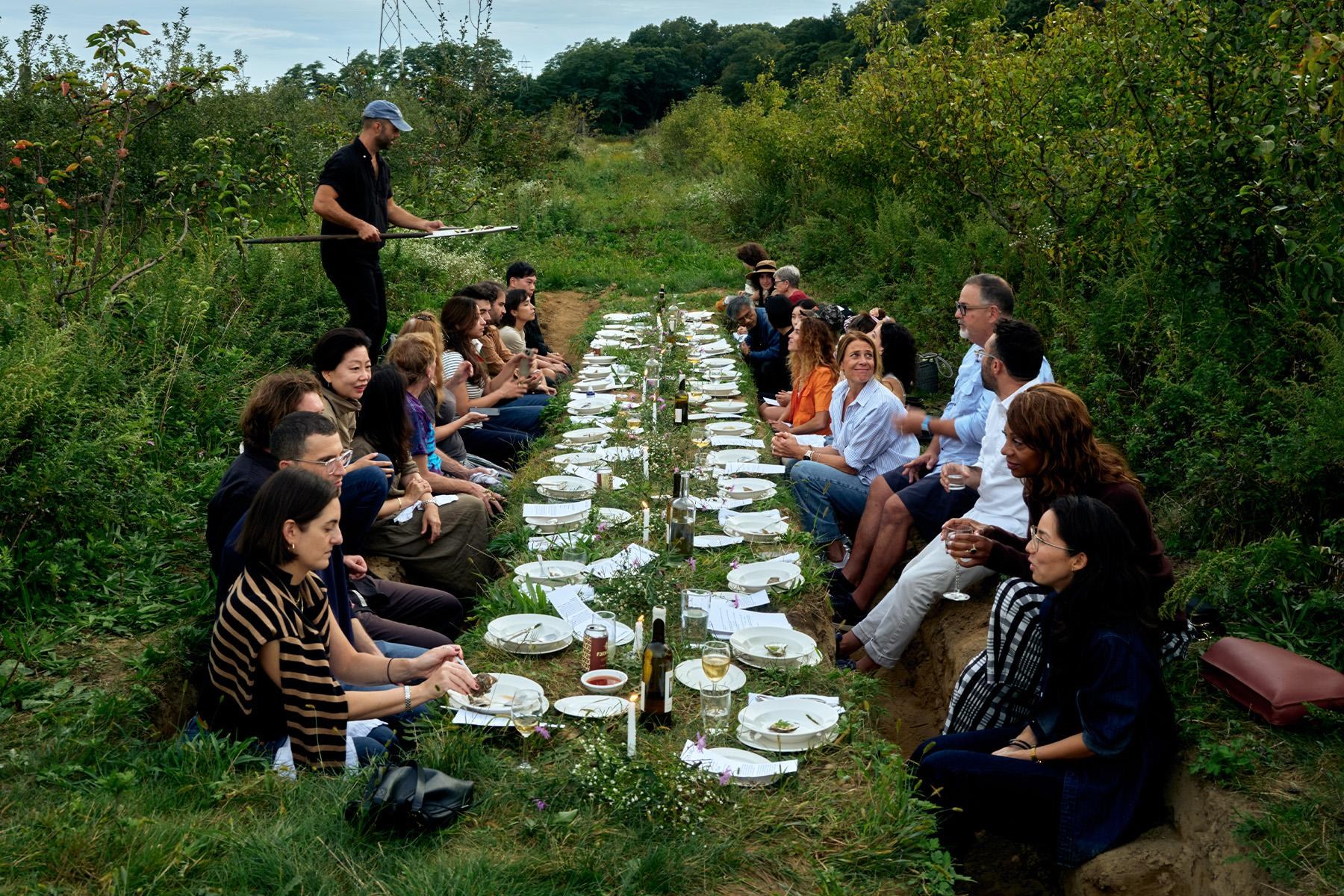
Denevan’s tables, for all of their bucolic achievement, do rely on a more clearly demarcated indoor-outdoor contrast, a retention of certain dining decorum. At every dinner, one can expect rows of chairs and an impossibly long, tablecloth-covered table (complete with the comforts of cutlery and tableware) that becomes a visual foil to its surroundings. Works like Lacloche’s Banquet on the Sea and Michel’s rockface food-painting picnic, however, were stripped of some of those dining conventions. That meant “almost none of the rituals resembled the way we normally eat,” Michel tells Eater. “There were no individual plates, [and] no courses; No clear distinction between audience and participant. And yet everyone arrived hungry and left nourished.” Last fall, a similar experience unfolded at a dinner titled Farm Is Table at Treiber Farms in Peconic, New York, where the table and seating was literally carved into the dirt by organizers — there were plates, but no tablecloth in sight, and the weed-strewn earth was instead elevated to the elbows of the diners, who were served local oysters off repurposed irrigation pipes from the farm.
Artist Allan Wexler was one of Farm Is Table’s co-organizers, and tells Eater that the event was one of 10 dinners building up to the March 2027 release of his new book, which reinterprets The Futurist Cookbook. The content of the nearly century-old conceptual Italian cookbook is rich with relational aesthetic dining fodder; its concept of Aerofood, for example, asks diners to serve themselves food with one hand while the other strokes sandpaper or velvet. Farm Is Table leaned into that notion of a sensory-heavy, social-norm-disrupting dinner by carving 30-foot-long troughs for its 30 guests (tickets were $125) to dine on a multicourse, locally sourced dinner. Wexler drilled holes into the ground, and put candles along the entire length. “As the sun went down and the moon came up,” he says, “it was a gorgeous evening. It just became magical.”
“It was very seafood-forward, and we really just worked with what was available locally,” Peter Treiber Jr., who co-runs Treiber Farms with his father, tells Eater. “There was delicata squash and mustard greens; we cooked tilefish, and Davy Jones Shellfish Co. delivered the oysters. It all created a bigger picture of what North Fork is about through the land and the sea.” As far as who attended the event, Treiber Jr. says it was a mix of friends, artists, and folks from New York City, with their common trait being an interest in a nature-driven, communal experience at the cross section of the arts and agriculture. “That cross section is something I’ve been exploring for years both as an artist and a farmer,” he says with a laugh, “it really is fertile ground.”
That fertile ground, however, is not always sown with purely artistic intentions. In recent years, earthwork meals have also attracted adept marketing minds who know that the well-oiled mechanics of social media are best suited for thumb-stopping images, even if they’re no longer art for art’s sake and are increasingly promotional commerce and brand activations. A few years ago, a dinner in this remote Menorcan stone quarry for the fast-fashion brands like Mango went viral; this past winter, L’Oréal carved a table and seating into the snowy mountains of Savoie, France, for an influencer brand trip. These events, while visually captivating, feel less attuned to the low-waste ethos of most earthwork artists and more tapped into the type of virality-baiting digital content (or worse, AI slop) that envisions them as moments of exclusivity and luxury.
Marketing has a history of mining the fringes of subcultures and art movements, but the ways in which these earthworks coax us into getting our hands and feet dirty feels especially precious in 2026. “It’s a pretty simple concept,” Treiber Jr. says about Farm Is Table, “but it’s pretty effective about getting people grounded. Being at root level.” Michel echoes this sentiment, explaining how such dining experiences can help us confront overconsumption, loneliness, and a growing disconnection from the land and people that nourish us.
“That’s the message,” he says, “food is the Trojan Horse.”