
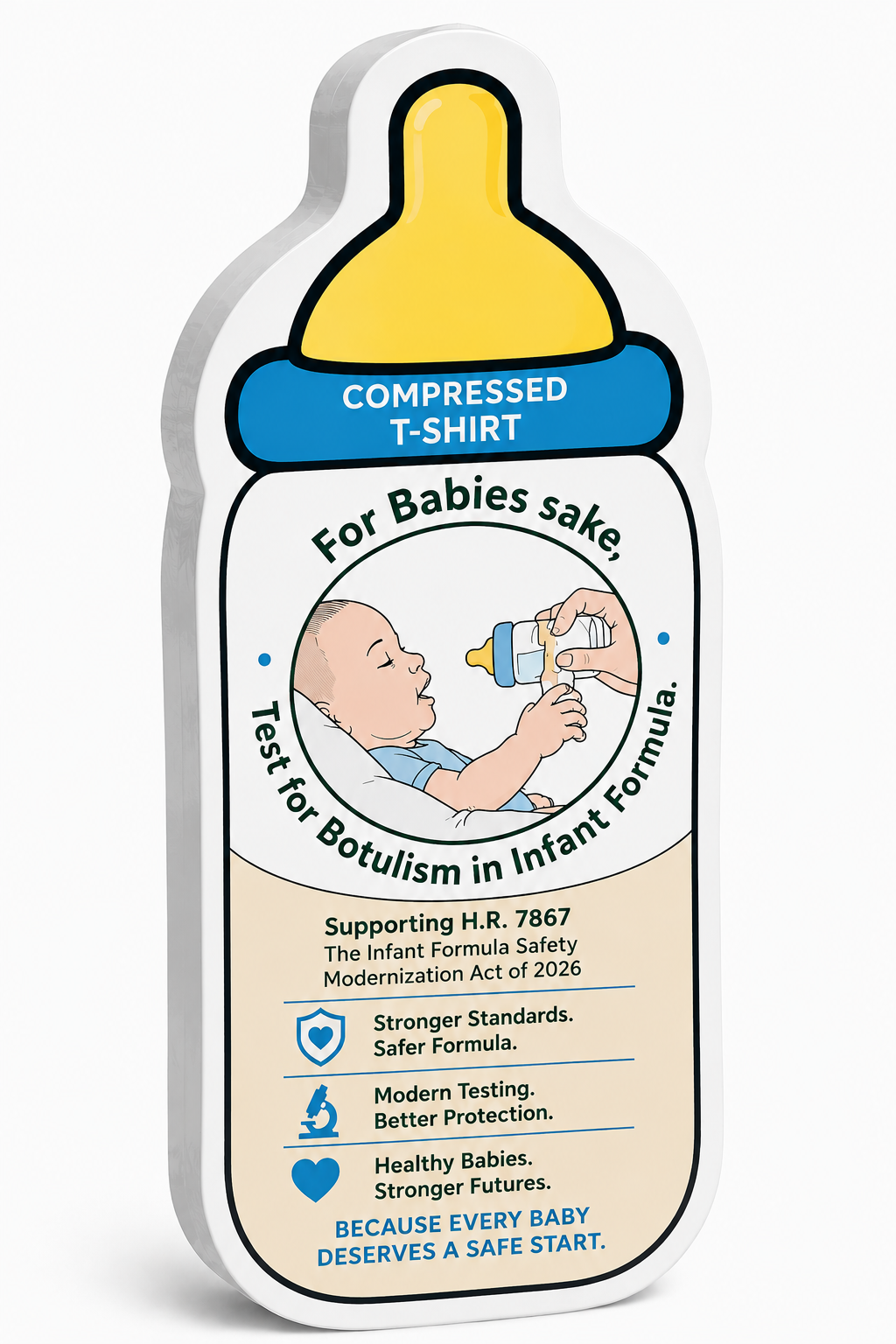
In early July I wrote that I had bought Congress a t-shirt — one for every member. The boxes are here.
Each shirt comes rolled and compressed inside a little plastic baby bottle small enough to hold in your palm. Unroll it and it reads: For Babies’ Sake, Test for Botulism in Infant Formula. Underneath, the bill — H.R. 7867, the Infant Formula Safety Modernization Act of 2026 — and the three things it delivers: stronger standards, modern testing, healthier babies. At the bottom, six words: Because every baby deserves a safe start.
Now the delivery, and here is where the calendar had opinions. The House left town at the end of July and does not return to Washington until August 31, for exactly one week. The Senate is here this week and then gone until September 14. Looks like delivery in September makes the most sense.
Here is why it still matters, five months after CDC declared the ByHeart outbreak over. Federal regulation still requires powdered infant formula manufacturers to test finished product for exactly two organisms — Salmonella and Cronobacter. That is 21 C.F.R. § 106.55, and Clostridium botulinum is not on it. It was not on it in November 2025, when 48 infants across 17 states were paralyzed after drinking ByHeart Whole Nutrition formula, the largest infant botulism outbreak in American history. It was not on it this spring, when four more babies, two to five months old, were hospitalized and treated with BabyBIG after drinking Nara Organics Whole Milk Organic formula. It is not on it this morning.
The FDA named the organism itself, in writing, in a March 8, 2023 Call-to-Action letter to the entire powdered formula industry — more than two years before the first ByHeart baby got sick. The hazard was on the government’s own record. The rule never caught up to it.
Both outbreaks run back through the same milk. Organic West Milk supplied it. Dairy Farmers of America spray-dried it. When FDA ran a trace-forward in 2025 to find every other formula maker that received that milk, Organic West handed over a customer list that left Nara off — a fact the agency has now stated plainly, along with Organic West’s later admission that the list was incomplete. The second outbreak was not bad luck. It was the first one still running, through a supply chain nobody had finished mapping.
H.R. 7867 fixes the part of that a statute can fix: it puts C. botulinum on the required testing list and mandates environmental monitoring inside the plants where this powder is made. It is bipartisan. The Health Subcommittee held its hearing on April 29. It has been sitting in Energy and Commerce ever since, waiting on a markup nobody has scheduled. The Senate passed S. 272 the same day that hearing happened — 22 to 0 in committee, unanimous consent on the floor — which tells you this is not a hard vote once somebody puts it on the calendar.
I have written the letters: to the House Energy and Commerce Committee, to the Senate HELP Committee, to Secretary Kennedy. I have sent the parents’ own words, in their own handwriting. Chairman Cassidy has demanded answers from Nara and ByHeart, and I gave him full credit for it. None of it has produced a markup.
A t-shirt in a plastic bottle will not produce one either. But it is small, it is strange, it does not throw away easily, and it says the entire argument in one line. Sometime in September a staffer is going to unroll one and read it out loud. That is the whole idea.