
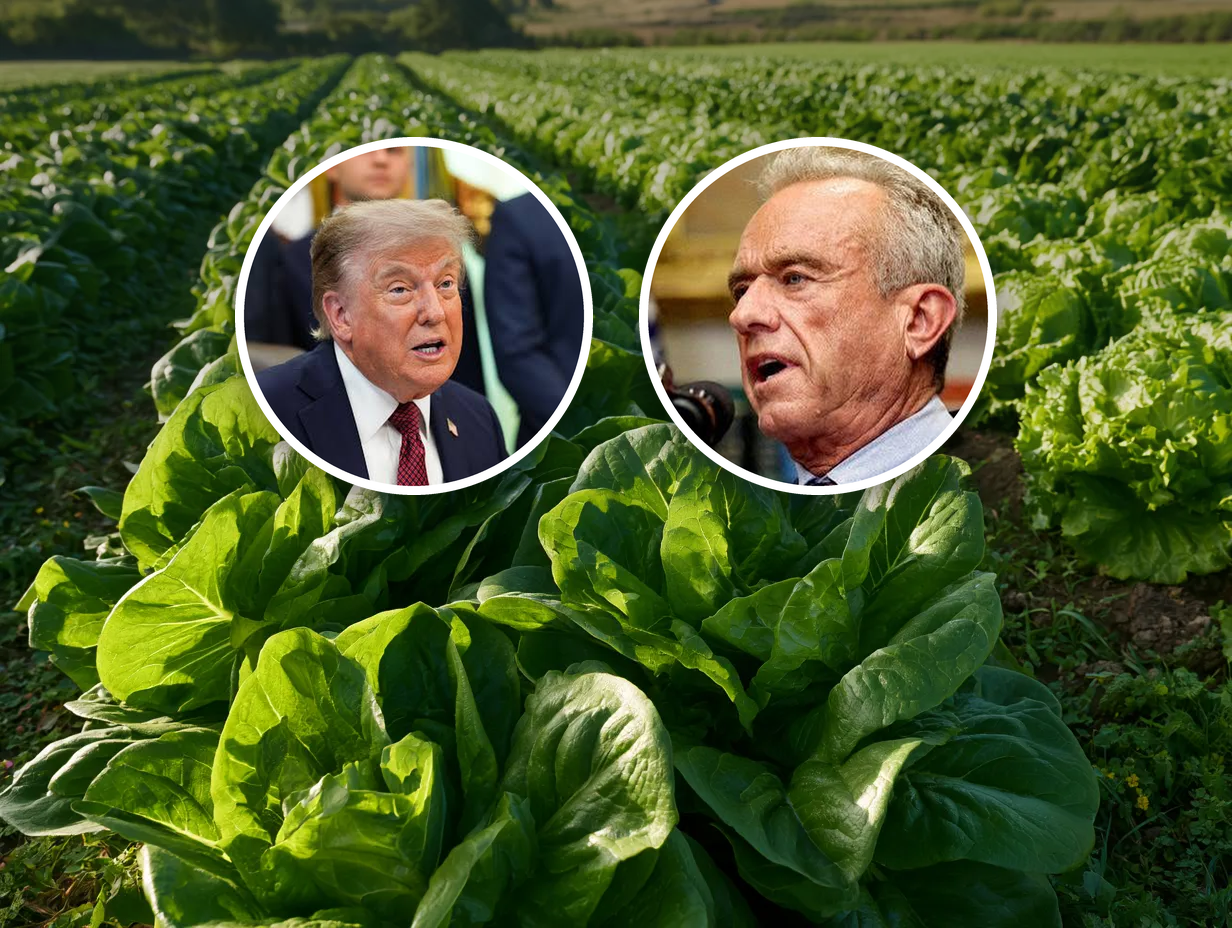
Ohio released new numbers today — 4,013 cases in 80 counties, up from 2,576 a week ago. Add the states up, one by one, all fifty of them, and the floor under this outbreak this morning is 20,927 people. Michigan alone reports 10,386 illnesses and 193 hospitalizations. Against that, the entire public record of what the President of the United States and the Secretary of Health and Human Services have said about the largest Cyclosporaoutbreak in American history fits comfortably on one page. I am going to lay that record out, and then I am going to say what they should have said instead.
The President has spoken once. On Friday, July 24, in the Oval Office, Fox News correspondent Peter Doocy asked him when it would be safe to eat lettuce again. He said he did not know, that he had “not thought about it, that it was the first time anyone had asked him” — and then he asked Doocy whether he had been eating lettuce lately. The room laughed. He finished by saying he would put a major tariff on Mexico because of the lettuce, and a tariff on Canada because of the wildfire smoke. That is the whole presidential record. It is one week old today, and nothing has been added to it.
The tariff line deserves one sentence of correction and no more. The iceberg lettuce at the center of the nine-state cluster was grown and processed in Guanajuato at a plant operated by a subsidiary of a company headquartered in Salinas, California. A tariff on Mexico is a measure aimed at an American company’s supply chain, and it is not a food safety measure.
The Secretary has spoken once as well. On Tuesday, July 21, at a briefing about health care fraud, Robert F. Kennedy Jr. was asked about the outbreak and said, “We do have the outbreak under control.” He said investigators had done extensive epidemiological forensics, that the source had been identified, and that the companies involved had implemented a recall. On that day, CDC’s outbreak page counted 1,644 illnesses in five states. Ten days later that same page counts 1,947 illnesses in nine states, and it has not been updated since July 24. CDC’s own surveillance page, a different page on the same website, counts 6,707 cases across 45 states. The states count 20,927. Three numbers, one agency, one outbreak.
Pressed at the same briefing on the surveillance cuts of Cyclospora, the Secretary said, “Those criticisms are invalid” and that there had been no cuts in the surveillance program — only in FoodNet, and only for what he called redundant surveillance.
The White House press secretary spoke on July 16, when the count was about 400 cases in four states. She said the administration had a handle on it, that CDC and FDA had the resources they needed, and that Americans should wash and cook their produce. The White House later told CNN it was aggressively coordinating response efforts. Take the washing advice on its own terms for a moment. FDA’s own guidance document says chlorine and other common antimicrobial treatments are not effective against this parasite, and CDC’s own health advisory says disinfecting or sanitizing produce might not fully eliminate it. Telling people to rinse it off is not advice.
Since then, the administration has spoken mostly through spokespeople. HHS senior press secretary Emily Hilliard has described a robust response and work with all fifty state health departments. On July 27, after the ranking member of the House Oversight Committee sent a document demand to Taylor Farms’ chief executive, White House spokesman Kush Desai said the notion that this administration would compromise on health and safety was absolutely false. That is the most recent thing anyone at the White House has said about this outbreak, and it was said about a subpoena-adjacent letter rather than about the sick.
Now set that beside what the career people have been saying the entire time. Acting FDA Commissioner Kyle Diamantas said on July 20 that the investigation continues, including into other potential sources and other commodities. Kari Irvin, who helps run FDA’s outbreak response network, told NBC on July 24 that the agency has multiple Cyclospora investigations open. CDC’s Gwen Biggerstaff has explained repeatedly that there is no whole genome sequencing route for this parasite, only targeted genotyping, which is slower and less precise. Not one person who does this work for a living has said this outbreak is under control. The two people who said it are the two people who do not do this work for a living.
Then there is what has not been said, and by whom. FDA has no Senate-confirmed Commissioner. CDC has no Senate-confirmed Director. The nominee, Dr. Erica Schwartz, had her hearing on July 15 and is still awaiting a vote; at that hearing Senator Patty Murray asked her to commit to reinstating required Cyclospora reporting, and she would not commit. Seven members of Congress have written seven letters in fourteen days — Klobuchar, Stanton, Ossoff, four Michigan House members, Gottheimer, Blumenthal and Booker, and Garcia. Not one has been publicly answered. Senator Ossoff’s second letter said the silence itself was the problem, and on that narrow point he is right.
I want to be fair about one thing, because it cuts against the easy version of this story. The Wall Street Journal reported on July 24 that Taylor Farms called the White House through a lobbyist to try to delay the announcement of the recall, and that the White House brought FDA onto the call. What happened next is the part that matters. The White House went back to FDA separately, asked how the traceback had been done, reviewed how the agency planned to communicate it, was persuaded, and told FDA to publish. That is the system working under pressure, and it deserves to be said out loud by the same people who criticize the rest.
Taylor Farms has been linked to the nine-state Taco Bell cluster and to the hospital cafeteria cluster in Keene, New Hampshire. It has not been linked to the thousands of people sick in the twenty-eight states that merely received its recalled product. Which means that of the 20,927 illnesses on the board this morning, roughly nineteen thousand have no named source at all. That is the sentence that should be keeping somebody in Washington awake, and I have not heard anybody in Washington say it.
There is a fourth number, and it is the one nobody in this administration has been willing to go near. In 2011 CDC’s own scientists, led by Elaine Scallan, published what is still the standard estimate of foodborne illness burden in this country. The Cyclospora line in it carries an underdiagnosis multiplier of 83.1 — for every laboratory-confirmed case, the model assumes about eighty-three people actually got sick. Applied to the only figure it can honestly be applied to, CDC’s 6,707 laboratory-confirmed cases, that is something on the order of 557,000 illnesses.
Be careful with that number. I am going to be careful with it here, because the caveats are real and I would rather state them than have them stated back at me. The honest answer to how many Americans this outbreak has made sick is that we do not know; that 20,927 is a floor and not an estimate; that the real figure is some multiple of it nobody can currently defend; and that the instruments built to answer the question were narrowed the year before it was asked. “Under control” is not a statement anyone can make about a number nobody can produce.
Here is what they should have said.
The Secretary should not have said “under control.” He should have said something closer to the truth, and the truth was available to him on July 21: we have identified the likely vehicle for one cluster of illnesses in nine states, we do not yet know what is making people sick in the other forty-one, we have this many people working on it, and here is what we are asking you to do while we find out. Nobody would have called that weakness. Everybody who works in this field would have recognized it as competence. Instead, he spent the credibility of his office on a phrase that was disproved by his own agency’s website inside of seventy-two hours.
The press secretary should not have told people to wash their lettuce. She should have told them what not to eat and for how long, which is the only instruction that has ever worked in a produce outbreak. She had FDA’s own document in front of her or could have. When the agencies know the advice does not work and give it anyway because it is the only advice that sounds reassuring, they are not protecting the public. They are protecting the podium.
And the President should have said something. Anything. It costs nothing and it is most of the job. Twenty thousand nine hundred twenty-seven Americans are sick, hundreds have been hospitalized, and people have been sick for weeks at a time with an illness that comes back in waves after you think it has ended. He could have said: this is real, my people are working on it, here is what we know today and here is where to find tomorrow’s update. The joke about the lettuce is not the offense. Not having thought about it is the offense, and he said that part himself.
There is a thread running through all of it, and it is not competence. It is transparency. FDA did not name Taylor Farms in its July 16 advisory because of trade secret restrictions, so the public was told about a single unnamed supplier in Mexico; the company recalled the next day. Eighteen months earlier the same agency closed a fatal romaine outbreak without ever naming the same company — eighty-nine people sick, one dead, seven cases of hemolytic uremic syndrome — and the name became public only because we sued for the unredacted pages. An agency that names companies late, or not at all, cannot then ask the public to take its reassurances on faith.
Here is what they should have done and still could do today.
1. Restore required Cyclospora reporting in FoodNet. I know the objection and I agree with half of it — FoodNet measures trends, it does not detect outbreaks. But it was narrowed eleven months before the largest Cyclospora outbreak this country has ever recorded, reinstating it costs almost nothing, and every letter Congress has sent asks for it.
2. Make cyclosporiasis reportable in every state, not merely nationally notifiable. Those are two different things: notifiable means CDC asks for the case, reportable means state law requires it. The parasite does not observe the difference, and neither should the count.
3. Publish one national number and update it. CDC currently maintains an outbreak page frozen at 1,947 since July 24 and a surveillance page reading 6,707, while the states themselves report 20,927. Pick a figure, define exactly what it counts, include probable cases, and refresh it on a schedule the public can rely on. An agency that will not publish the size of a problem cannot expect to be believed about the solution.
4. Grant the citizen petition that has been sitting at FDA since February 4. Stop Foodborne Illness asked the agency to adopt a policy of naming every company associated with a foodborne illness outbreak, recall or no recall. It requires no rulemaking; the Commissioner could grant it this week with a memorandum. My one amendment stands: disclosure has to reach the processor and the grower, because in a produce outbreak there is very often no brand on the bag at all.
5. Bring back the Microbiological Data Program, and this time give it a parasite target. MDP was created under President Bush’s 2001 Food Safety Initiative and tested about fifteen thousand produce samples a year — bagged lettuce and spinach, cilantro, hot peppers, tomatoes, sprouts, melons — for roughly $4.5 million a year, and it accounted for something like eighty percent of all federal produce pathogen testing until it was zeroed out and shut down in December 2012. I have been asking for it back since 2024. The honest caveat, which I would rather state myself: MDP tested for bacteria, not for parasites, so restoring it exactly as it was would not have caught this outbreak. Restore it with Cyclospora on the panel and the sampling pushed upstream toward the field, and while we are at it add the parasite to CDC’s national wastewater surveillance network, which reaches roughly fifteen hundred sites and about half the country and does not look for this organism at all.
6. Put the FSMA 204 traceability rule back on its original schedule instead of 2028. Susan Mayne, who has actually run lettuce tracebacks, said on national television this week that it would have been enormously helpful here, and that without it the same thing happens again next summer.
7. Name Cyclospora in the pre-harvest agricultural water rule. The only numeric microbial criterion in Subpart E is generic E. coli, and FDA’s own guidance says fecal-indicator testing will not identify this parasite. We are requiring growers to test water for the wrong organism and calling it a safeguard.
8. Stand up the independent board Frank Yiannas has been asking for since 2025 — an NTSB for foodborne outbreaks, investigating across agency lines, publishing root cause and lessons, with no stake in the reputation of the agency whose work it is reviewing. He has said again this month that the federal response here is approaching a catastrophic level of mismanagement, and he is a former deputy commissioner of FDA and a past president of the professional society that met in New Orleans this week. His framing is the right one — the point is not to find fault; it is to find facts. Former FDA Commissioner Scott Gottlieb made a version of the same point on Face the Nation on Sunday when he said the breakdown was in identifying the initial cluster, and that Michigan’s state health officials led that work rather than Atlanta.
Not one of those eight is a partisan measure, and it is worth saying that the Microbiological Data Program was created under a Republican president and killed under a Democratic one. Six of the eight were federal policy or federal practice inside the last fifteen years. All eight would have made this month shorter.
I have been doing this since 1993, and I have watched administrations of both parties handle outbreaks badly. What is different this time is not the mistakes. Mistakes are ordinary; the false positive was ordinary; a hard parasite with a two-week incubation period is ordinary bad luck. What is different is that seventeen days into the worst Cyclospora outbreak this country has ever had, nobody at the top has said the number out loud. Twenty thousand nine hundred twenty-seven. Say it, and then say what you are going to do about it.