
For the second time in seven months, I am writing about a baby formula that is carrying the toxin that causes botulism. For the second time in seven months, the implicated ingredient is whole milk powder. And for the second time in seven months, the product was sitting on the shelf at Target when parents reached for it.
On June 13, 2026, Nara Organics recalled every can of its Whole Milk Organic Powdered Infant Formula after the FDA and CDC linked it to three cases of infant botulism in California, Pennsylvania, and Washington. All three babies — between two and five months old — were hospitalized and treated with BabyBIG. Mercifully, no one has died. The formula was made in Europe and sold across the country through Target stores, Target.com, and Nara.com between July 2025 and June 2026.
If that sounds familiar, it should. In November 2025, the ByHeart Whole Nutrition Infant Formula outbreak sickened 48 infants across 17 states — the first formula-linked infant botulism outbreak this country had ever recognized. Whole-genome sequencing tied it to *Clostridium botulinum* in organic whole milk powder. My firm represents more than twenty of those families. I have sat with them. There is nothing abstract about an infant on a ventilator.
I have a simple question, and I think every parent in America is entitled to ask it with me: “Where are the FDA and the formula industry on making sure the formula we feed our kids is safe?” I put both in the same sentence on purpose. One of them wrote the warning. The other one received it. Neither one stopped this from happening — twice.
They Were Warned. In Writing. Naming the Toxin.
This is what makes me angry, and it should make you angry too. None of this was a surprise to the agency or to the industry.
On March 8, 2023 — more than three years ago — the FDA sent a “Call to Action” letter to every infant formula manufacturer, packer, distributor, exporter, importer, and retailer in the country. In that letter, signed by the Commissioner of Food and Drugs and the Director of the Center for Food Safety and Applied Nutrition, the agency wrote, in plain language and naming the organism, that “[h]istorical associations between powdered infant formula and pathogens such as Cronobacter spp., Salmonella, and Clostridium botulinum should be considered when designing and implementing controls for the safe manufacture of all foods for infants and young children.”
Read that again. The FDA told this entire industry — in writing, naming Clostridium botulinum — that powdered infant formula had a documented history of botulism and that manufacturers had to control for it.
That was 2023. Then came ByHeart in 2025. Now Nara in 2026.
When a regulator hands an industry a roadmap of exactly how children will be hurt, and children are then hurt that exact way — twice in seven months — that is not bad luck. It was foreseeable. It was preventable. And it keeps happening.
And let me be clear about who got that roadmap. That March 2023 letter was not addressed to the public. It was addressed to the manufacturers, packers, distributors, importers, and retailers — the industry itself. The FDA did its part: it identified the hazard and told the people who make and sell this product, in writing, to control for it. The companies that make infant formula, and the retailers who put it on the shelf, were handed the exact warning three years before these babies got sick.
A Recall Is Not a Food Safety System
Here is what I want people to understand. By the time you read a recall notice, the harm is already done. The babies are already in the hospital. A recall after the fact is not a food safety system. It is a bad apology.
What Parents Should Do Right Now
If you have Nara Organics Whole Milk Organic Powdered Infant Formula in your home, stop using it today. Do not throw it away yet — label the container “DO NOT USE,” photograph the label and lot code, and store it safely away from other food for at least a month, because your state health department may want to test it.
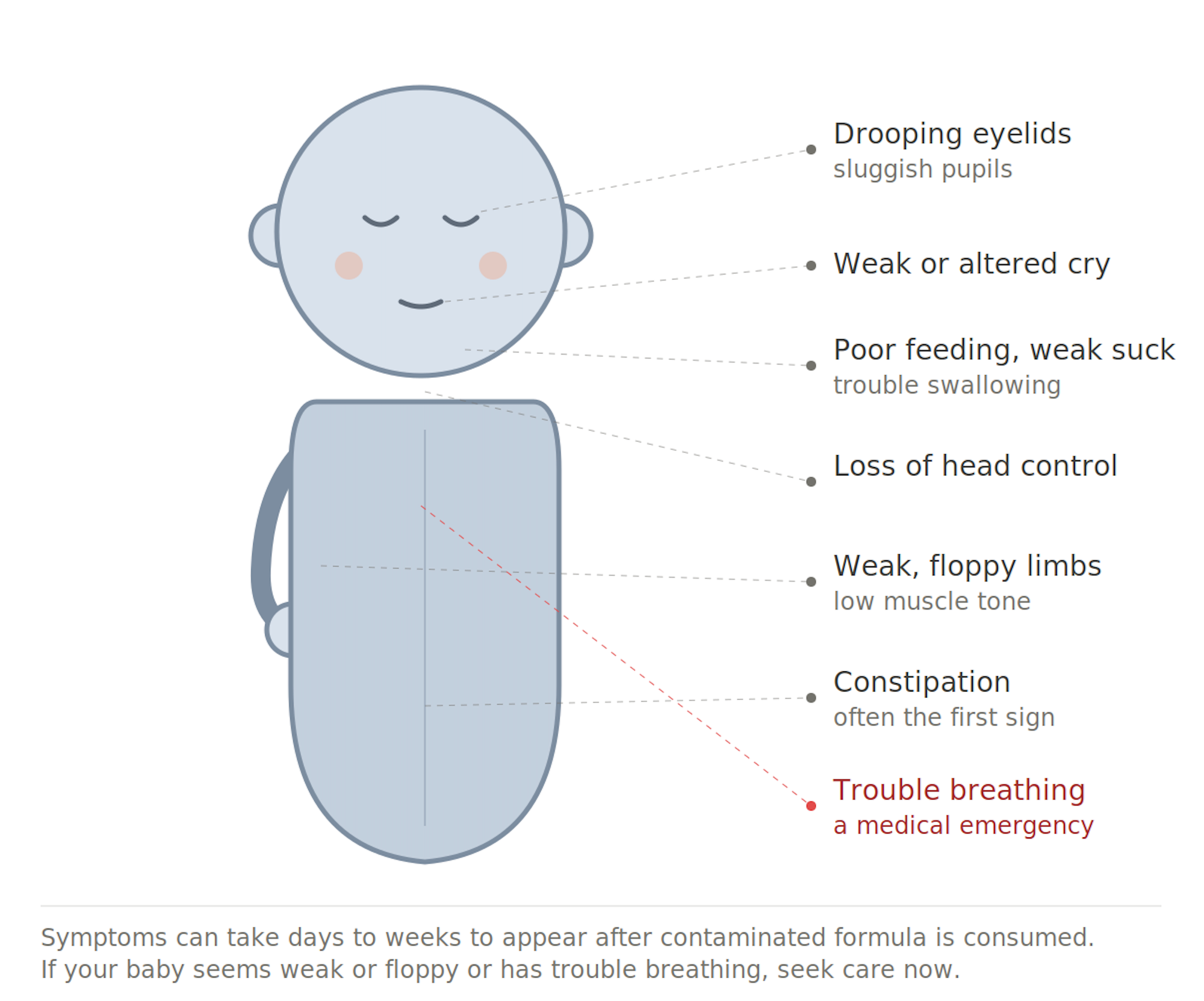
Infant botulism often starts quietly: constipation, poor feeding, a weak cry, loss of head control, trouble swallowing. It can progress to difficulty breathing. Symptoms can take weeks to appear after the formula is consumed. If your baby is feeding poorly, can’t hold up their head, or seems unusually weak or floppy, do not wait. Call your doctor now. Physicians who suspect infant botulism can reach the Infant Botulism Treatment and Prevention Program 24/7 at 510-231-7600.
Thirty Years, and the Same Lesson
I have spent more than thirty years doing this work, since the 1993 Jack in the Box outbreak. The lesson has never changed: outbreaks are not accidents. They are the predictable result of known hazards left uncontrolled. The only thing that has changed here is that the FDA put the warning in writing, named the toxin, handed it to the industry — and the children got sick anyway.
The babies in California, Pennsylvania, and Washington will, I hope, recover. But the next parent standing in the formula aisle deserves a system that protects their child *before* the recall — one where the agency requires real prevention and the companies actually deliver it, instead of a warning letter to the industry, two outbreaks, and a request that the rest of us check our pantries.
Where are the FDA and the formula industry? That is the question. Our kids are waiting on the answer.
To sign up for a free subscription to Food Safety News: https://www.foodsafetynews.com/subscribe/