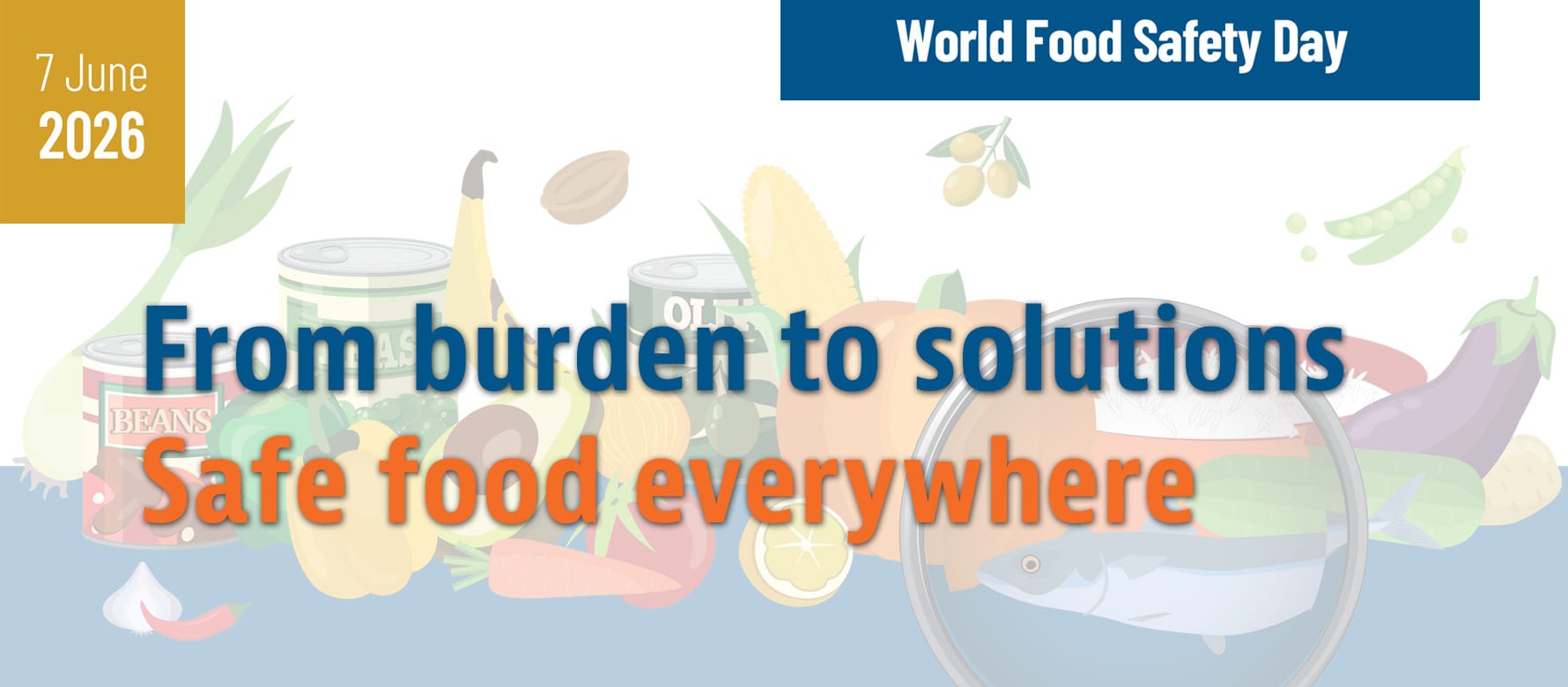
Today is World Food Safety Day, and this year the World Health Organization and the Food and Agriculture Organization have given us a theme that sounds almost like it was written for the work I have spent the last three decades doing: “From burden to solutions – safe food everywhere.”
I want to sit with that word — burden — for a moment, because the numbers WHO released to mark the day are staggering. The agency now estimates that unsafe food causes roughly 866 million illnesses and 1.52 million deaths every year. Nearly one in nine people on earth gets sick from food in a given year. The 2026 estimates are the first major update since WHO’s landmark 2015 report, and they don’t just refresh the old figures — they expand the picture, adding heavy metals like arsenic, cadmium, lead, and methylmercury to the list of hazards, and for the first time offering country-by-country estimates so nations can see exactly where their own burden lies.
Those are big numbers. They are so big that they can become abstract — a statistic you nod at and scroll past. I have never had that luxury.
When I read “866 million,” I don’t see a number. I see Brianne Kiner, who spent months in a coma after eating a hamburger in 1993. I see four children who didn’t survive that Jack in the Box outbreak — the outbreak that ended my career as I had planned it and started the one I have now. I see the families I am sitting across from this year: the parents of infants paralyzed by Clostridium botulinum in ByHeart formula, the people across 36 states sickened by Salmonella in moringa supplements they bought because they thought they were doing something good for their health. The burden is not a chart. It is a person, and usually it is a person who did absolutely nothing wrong except trust that their food was safe.
But here is what I keep coming back to, and why this year’s theme matters so much to me. The second half of it — “to solutions” — is not wishful thinking. I know it is achievable because I have watched it happen.
The Jack in the Box outbreak led directly to the USDA declaring E. coli O157:H7 an adulterant in ground beef in 1994. That single regulatory decision has prevented countless illnesses in the years since. In 2012, six more strains of non-O157 STEC — the “Big Six” — were added. Every one of those solutions came from the same place: someone counted the burden, named it, refused to look away, and demanded that the data drive a response. That is the entire theory of this year’s observance. Surveillance data, honestly collected and openly shared, is what turns a tragedy into a prevented one.
Which brings me to the part of today that I cannot celebrate.
Start with the most basic fact of all: the United States is no longer a member of the organization that leads this day. On January 22, 2026, after a yearlong process, the U.S. completed its withdrawal from the World Health Organization — the body that, beginning in 1948 with the United States as a founding member, has spent more than seven decades building the very global food safety surveillance the 2026 theme is built on. We were, for most of that history, WHO’s single largest funder. Now WHO publishes the most important update to the global foodborne disease burden in a decade, and the country that did more than any other to make that work possible has walked away from the table. The flag still flies outside the headquarters in Geneva. We are the ones who left.
And we did not stop there. You cannot get from burden to solutions if you are dismantling the machinery that measures the burden. Over the past year I have written, again and again, about the budget and staffing cuts hollowing out the FDA, the CDC, and FSIS — the very agencies whose epidemiologists, lab scientists, and inspectors generate the American slice of the data WHO is asking the world to act on. An outbreak that is never detected produces no data. A traceback that is never completed names no source. A whole-genome sequence that is never run links no illness to its cause. The burden does not disappear when we stop counting it. It just disappears from the page.
And when the data does exist, we are increasingly being told we are not allowed to see it. I have spent a good part of this year fighting the FDA’s reflexive over-redaction — supplier names blacked out under the deliberative-process exemption, traceback documents withheld, the public left to trust that someone, somewhere, is handling it. You cannot ask consumers, food businesses, and policymakers to make “informed choices” — WHO’s words — while denying them the information.
So here is my World Food Safety Day message, the same one I have been delivering in courtrooms and on this blog for thirty-three years: the burden is real, the people behind it are real, and the solutions are within reach — but only if we are willing to fund the counting and share the count. Data is not bureaucracy. Data is the difference between a parent reading a recall notice and a parent reading an autopsy report.
From burden to solutions, safe food everywhere. I believe in it. Today, of all days, let’s act like we mean it.